
For thousands of Americans, the Isle of Mull and the sacred isle of Iona represent more than just scenic travel destinations; they are the “home place,” the ancestral soil where families faced uprooting during the tumultuous centuries of Highland migration.
Discovering that your family roots trace back to the Inner Hebrides is a profound realization, but it presents unique challenges for the family historian. These islands in western Scotland were home to families who emigrated to North America in distinct waves between the mid-eighteenth and late nineteenth centuries, driven by forces ranging from voluntary ambition to the devastating clearances.

Tracing ancestry from Mull or Iona requires a structured, historically informed approach because Scottish records follow a fundamentally different organization than American records. Successful research begins not in Edinburgh, but in the United States, by understanding parish boundaries, the complex estate system, and which documents provide the most reliable information for bridging the Atlantic.
The Foundation: Exhausting U.S. Records First
The most common error Americans make is attempting to search Scottish archives before fully exhausting records on their side of the ocean. Searching for a name like “John MacLean” or “Mary MacDonald” in Scotland without a specific parish or township will yield hundreds of indistinguishable results. Therefore, the research must begin by gathering every scrap of existing information in the United States to pinpoint the immigrant ancestor’s origins. Federal census records from 1850 onward are the first major tool; while early censuses may only list “Scotland” as a birthplace, later entries—particularly the 1900 census, which asks for the year of immigration and naturalization status—can provide critical clues.
Beyond the census, researchers must dig into death certificates, obituaries, tombstones, and naturalization documents. These often contain vital details that census takers missed, occasionally specifying “Argyllshire,” “Mull,” or even a specific village like “Tobermory” or “Bunessan.” Military records provide a goldmine of information because many Highlanders served in British regiments before settling in America, or in American units during the Civil War, where enlistment papers often recorded specific birthplaces. Researchers should scour passenger manifests, while sometimes scarce for early migrations, for “cluster” groups or families traveling together from the same estate. Confirming the earliest immigrant ancestor and collecting details for each family member, including full names, birth years, locations, and family connections, creates the necessary bridge to Scottish sources.
The Vital Role of American Church Records
Church records in the United States are frequently more detailed than civil records and are particularly valuable for Highland research. Many emigrants from Mull and Iona were devout Presbyterians who brought their “lines” or transfer letters with them to American congregations. Registers of baptisms, marriages, and membership rolls in the U.S. often identify a specific Scottish parish to distinguish one MacLean family from another. This allows researchers to narrow their search from the entirety of Scotland to a manageable geographic area. Furthermore, burial registers and session minutes may mention emigration details or reference family members who remained behind in Scotland, providing a cross-reference that verifies the link.
It is also important to note that not all Highlanders were Presbyterian. Significant pockets of Mull, and families associated with certain estates, remained Episcopalian or Catholic. Identifying the religious denomination of your ancestor in the U.S. is a strong clue as to where they might have lived on Mull. Do not rely solely on surnames; verification through multiple U.S. documents is essential before consulting Scottish archives.
Decoding the Geography: Mull’s Parish Structure
To find an ancestor in Scottish records, you must know their parish. Historically, the Isle of Mull formed part of the county of Argyllshire and contained three primary parishes. Understanding these boundaries marks the single most critical step in your research because both church and civil authorities organized records by these districts. Searching broadly for “Mull” is often impossible in archival databases; you must search by parish.
Kilninian and Kilmore: This parish covers the northern part of Mull, including the main town of Tobermory, the village of Dervaig, and the area around Calgary Bay. It also includes the smaller islands of Ulva and Gometra, which suffered heavily during the clearances. Families from this area often emigrated during the mid-19th century potato famine.
Torosay: This parish encompasses the eastern and central parts of the island, including Craignure, Lochdon, and Salen. It was the heartland of the MacLean of Duart and Lochbuie estates. Records here can often be cross-referenced with estate papers from these major landowning families.
Kilfinichen and Kilvickeon: This vast parish covers the southwestern peninsula known as the “Ross of Mull” and, crucially, includes the Isle of Iona. If your ancestors were from Iona, their births and marriages before 1855 will be found in the registers of Kilfinichen and Kilvickeon, not in a separate “Iona” registry. This is a common stumbling block for researchers who assume Iona had its own independent records during the early period.

Mastering Old Parish Registers (Pre-1855)
Before 1855, the recording of vital events was the responsibility of the Church of Scotland. These records, known as the Old Parish Registers (OPRs), document baptisms and marriages, and occasionally burials. They are the primary source for tracing families in the late 18th and early 19th centuries. However, they are not comprehensive. Registration was not compulsory, and fees, distance from the church, or religious dissent (such as belonging to the Free Church after 1843) meant that many events went unrecorded.
Despite these limitations, OPRs are invaluable. Entries usually name the father and sometimes the mother (often with her maiden name, a boon for genealogists). Crucially, they often list the specific township or farm where the family lived, such as “Shiaba,” “Uisken,” or “Fanmore.” In small island communities where everyone shared a handful of surnames, the township is the key identifier. Finding a “John MacLean” is not enough; finding “John MacLean, tenant in Ardtun” distinguishes him from his namesake three miles away. Tracking repeated family names within a specific township in the OPRs can link multiple generations and help verify identity across documents.
It is also worth consulting “Kirk Session” records. These are the disciplinary records of the church court and often contain details not found in registers, such as paternity cases for illegitimate children or lists of the poor receiving parish relief. These can add flesh to the bones of a family tree, revealing the social struggles your ancestors faced.
The “Golden Era”: Civil Registration After 1855
The year 1855 marks a watershed moment in Scottish genealogy. In that year, statutory civil registration was introduced, removing record-keeping duties from the church and placing them with the state. Scottish civil records from this period are among the most detailed in the world. Birth, marriage, and death certificates from 1855 onward include extensive information: parents’ full names (including mother’s maiden name), occupations, usual residences, and often the names of witnesses.
For Americans, the most valuable document is often the death certificate of an ancestor who stayed behind in Scotland or an elderly relative who died shortly after 1855. A death record will list the deceased’s parents, effectively jumping the research back a full generation with high certainty. These records may also indicate the parish or town of origin, helping researchers connect to the more fragmentary OPRs. To use civil registration effectively, you need a probable parish or township because the indexes can be large. Checking multiple records ensures accuracy, as families often moved within Scotland, perhaps to Glasgow or Greenock, before eventually emigrating or dying.
The Power of Estate Records and Tenancy Documents
While church and state records focus on vital events, estate records focus on the land, and in the Highlands, the land was everything. Great estates, primarily those of the Duke of Argyll (the Campbells) and the MacLeans, organized Mull’s communities. Families lived as tenants or sub-tenants (“cottars”), and rental rolls, arrears books, and estate correspondence document their presence. These documents are often the only way to trace families in the early 18th century, predating most church registers.
The Argyll Papers, held at Inveraray Castle and increasingly available through archives, offer particularly rich information. They contain censuses of the Duke’s estates (including the Ross of Mull and Iona) taken decades before the government census, listing heads of households and the number of inhabitants. Estate records provide evidence of residence, economic conditions, and the brutal reality of the clearances. These documents identify evicted tenants, those in debt, and individuals whom the estate “assisted” to emigrate. For Americans tracing ancestors displaced by the Highland Clearances, estate records provide concrete, often heartbreaking, evidence connecting family tradition to historical fact.
Iona: A Special Case in Record Keeping
Iona played a central role in Scottish religious history, but for the genealogist, it is a small community with a unique paper trail. The monastery founded by Columba shaped the island’s history, but by the time of mass emigration, the population was a mix of crofters and fishermen living under the ownership of the Duke of Argyll. While medieval records rarely mention ordinary residents, the abbey’s influence helped establish a parish structure that church and civil authorities maintained even after the Reformation.
Researching Iona ancestors requires specific attention to the “Ross of Mull” records (Kilfinichen and Kilvickeon). However, because Iona was a distinct and contained community, it is often easier to reconstruct whole family groups here than on the mainland of Mull. The island’s small size meant that intermarriage was common, and estate lists for Iona are often very complete. Understanding Iona’s history, specifically the rise of tourism in the late 19th century and the restoration of the Abbey, can also explain why some families stayed while others left.
Migration Clusters and Passenger Lists
Highlanders rarely emigrated alone. They moved in “clusters”, groups of extended family, neighbors from the same township, and religious congregations. Passenger lists from the eighteenth and nineteenth centuries are notoriously incomplete, but when they exist, you should analyze them not just for your ancestor, but for everyone on the ship. If your MacLeans arrived in North Carolina in 1739 or Nova Scotia in 1801, look at the other names on the manifest. Finding a neighbor from the township of “Lee” or “Assapol” on the same ship can confirm your ancestor’s origin even if their specific entry is vague.
This “cluster” phenomenon continued in America. U.S. census records often show settlement patterns where former neighbors from Mull or Iona stayed close to each other in the New World. You might find a dozen families from the Ross of Mull living in the same county in Ohio or the same district in Ontario. Following these clusters helps reconstruct migration pathways and identifies the correct parish on the islands. If your ancestor’s neighbors are all from Torosay, chances are your ancestor is too.
Unlocking the Code of Highland Naming Conventions
One of the most powerful tools for bridging the gap between American and Scottish records is the Highland naming convention. Families followed a rigid traditional pattern for naming children, which can effectively predict the names of an earlier generation. Typically, parents named the first son after the paternal grandfather, the second son after the maternal grandfather, and the third son after the father. Families followed a similar pattern for daughters: maternal grandmother, paternal grandmother, and then the mother.
When American census records show repeating names across generations, such as a persistent use of “Lachlan,” “Hector,” “Flora,” or “Euphemia”, this is not coincidence; it is evidence. By applying this pattern to your immigrant ancestor’s children, you can hypothesize the names of their parents in Scotland. Comparing these predicted names with baptismal records in Mull or Iona often confirms relationships. While naming conventions alone do not constitute absolute proof, when used in conjunction with parish registers and estate documents, they provide a strong probabilistic framework for establishing lineage.
Modern Science: Using DNA to Break Brick Walls
When gaps in the paper trail exist, perhaps due to a missing parish register or an undocumented eviction, modern DNA testing provides an essential tool for Mull and Iona research. Y-DNA testing (tracking the direct paternal line) is particularly useful for distinguishing between the different branches of major clans like the MacLeans, MacDonalds, or Campbells. Surname projects often have distinct genetic signatures for the “MacLeans of Duart” versus the “MacLeans of Coll.”
TOP-SELLING CONSUMER DNA TEST: From your origins in over 3,600 places around the world to the most connections to living relatives, no other DNA test kit delivers an experience as unique and interactive as AncestryDNA.


Autosomal DNA (standard ancestry testing) can also be powerful, but it requires caution. Because the population of Mull and Iona was small and isolated, “endogamy” (marrying within the community) was common for centuries. This means that you may share more DNA with a match than is typical, making distant cousins appear closer than they are. However, finding a genetic match who still lives on Mull, or who has a documented tree leading back to a specific township, can be the breakthrough that bypasses missing paperwork.
Tracking Families Across North America
Mull and Iona emigrants settled in specific regions depending on when they left. The earliest waves (1730s-1770s) often went to North Carolina’s Cape Fear Valley or New York. Post-Revolutionary War migrants, often Loyalist soldiers, settled in Nova Scotia (particularly Pictou and Antigonish) and Ontario (Glengarry County). The later waves, driven by the clearances and potato famine (1840s-1880s), often entered through Canada or New York and moved to the Midwest, Ohio, Illinois, Wisconsin, or remained in industrial centers like Glasgow before shipping out.
Researchers should always consider movements within the United States and cross-border migration with Canada. It is common to find a family in the 1851 Census of Canada who then appears in the 1870 US Census in Michigan or Minnesota. Military records from both the British Army (pre-migration) and American forces can verify identity. Service records often provide physical descriptions and birth locations that are absent from civil records.
Avoiding Common Pitfalls
The path to tracing Mull ancestry is fraught with common errors. Do not assume that every MacLean is from Mull or every Campbell from Argyll; these names are ubiquitous throughout the Highlands. Geographic confirmation via a document is essential. Furthermore, be wary of unsourced online family trees. Many contain speculative connections that link immigrant ancestors to prominent chiefs or castle owners without evidence. Always verify dates, parishes, and relationships with primary source documents.
Expect spelling variations because census takers who did not speak Gaelic Anglicized names inconsistently. “MacLean” may appear as “McLane,” “MacLaine,” or even “Clean.” “MacDonald” can be “McDaniel.” “Sarah” in an American census might be “Morag” or “Marion” in a Scottish birth record. Recognizing these linguistic shifts prevents missed records and ensures accurate identification.
The Return: Visiting Mull and Iona With Purpose
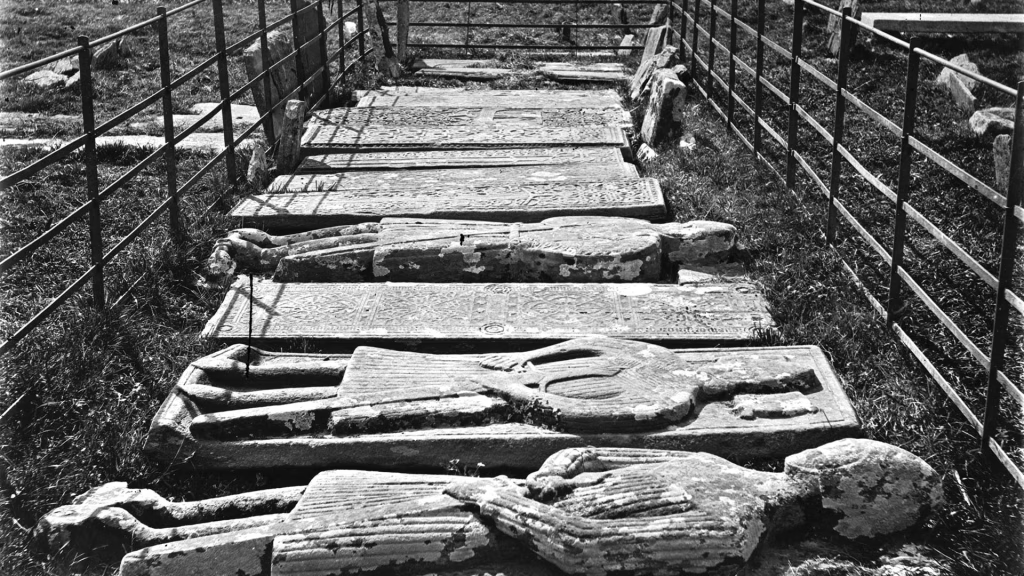
Ultimately, the goal of this research is often a physical return to the islands. A visit to Mull and Iona carries the most meaning when you document and specify your research. Instead of simply driving the tourist route, you can walk the specific ruined township where your ancestors lived, often finding the remains of the stone “blackhouses” still standing in the heather. You can stand in the churchyard at Kilmore or the Reilig Odhráin on Iona and know that your forebears lie there, perhaps in unmarked graves.
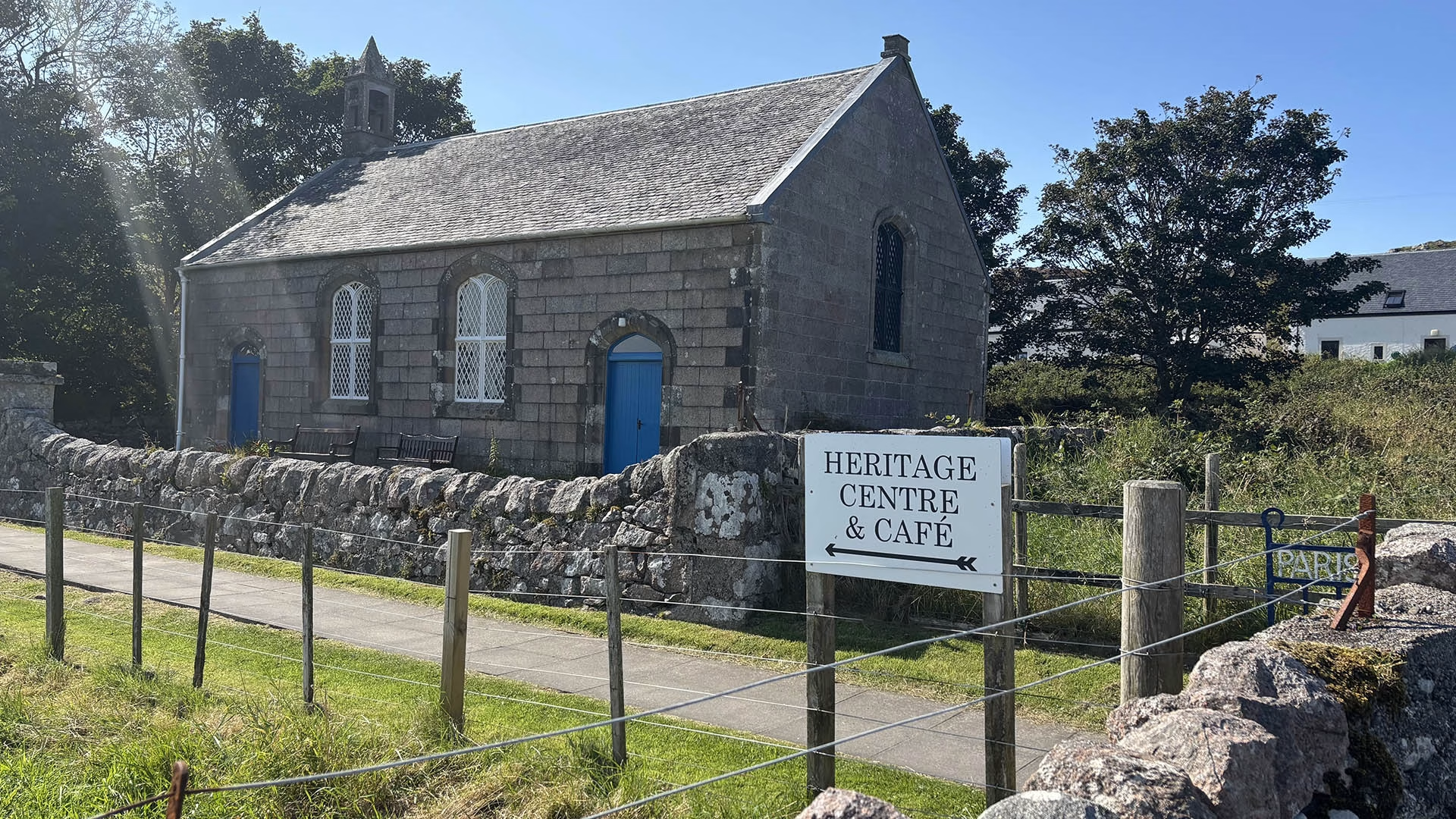
Consult local resources upon arrival. The Mull Museum in Tobermory and the Iona Heritage Centre, and the Ross of Mull Historical Centre in Bunessan hold local genealogies, school photos, and rent books that are not available online. Visiting with confirmed records connects the stunning landscape directly to your personal history, transforming a vacation into a pilgrimage. By combining rigorous U.S. research with a deep understanding of Scottish records, land tenure, and history, American descendants can reclaim their heritage, linking the new world to the old in a documented, meaningful way.
American Resources
- FamilySearch – Free database for U.S. Census, probate, and church records.
- National Archives (NARA) Immigration Records – Official guide to passenger lists and naturalization records.
- Find a Grave – Essential for locating tombstones which often list the specific Scottish parish.
- Ellis Island Foundation – Passenger search for immigrants arriving in New York (1892–1957).
Scottish Resources
- ScotlandsPeople – The official government site for OPRs, statutory registers, and wills.
- Mull Genealogy – A specialist site dedicated specifically to Isle of Mull families and records.
- Mull Museum – The central museum for North and East Mull, holding estate papers and the “Jo Currie” index.
- Ross of Mull Historical Centre – Vital archive for Bunessan, Kilfinichen, and Iona families, holding local records not found online.
- National Library of Scotland Maps – Detailed historical maps to locate cleared townships and crofts.
- Iona Heritage Centre – Local archives and history specific to the Isle of Iona.
- National Records of Scotland – Catalog for estate papers (Argyll, MacLean) and kirk session records.
- Clan MacLean Worldwide – Genealogy resources for the dominant clan of Duart and Lochbuie.