

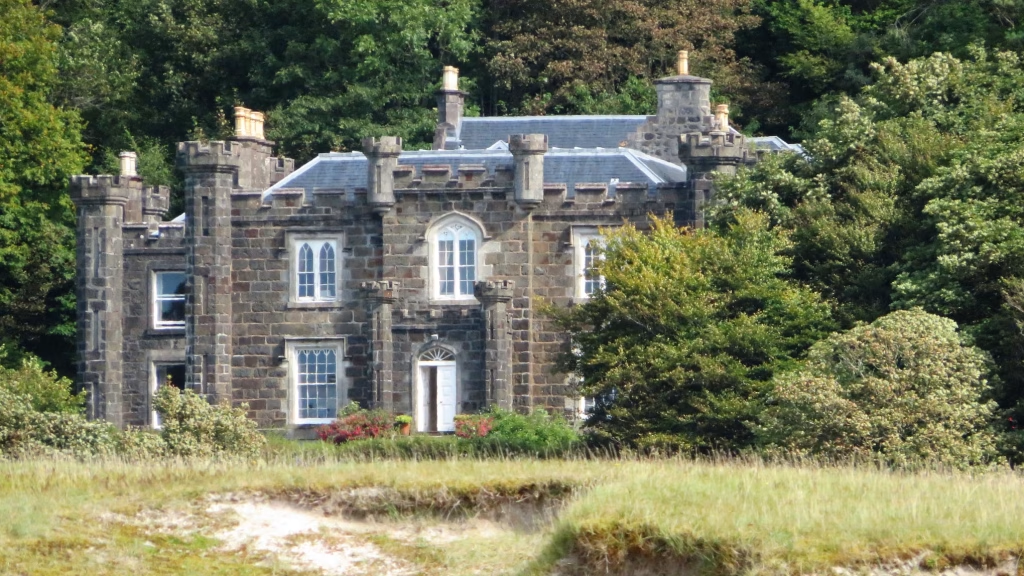
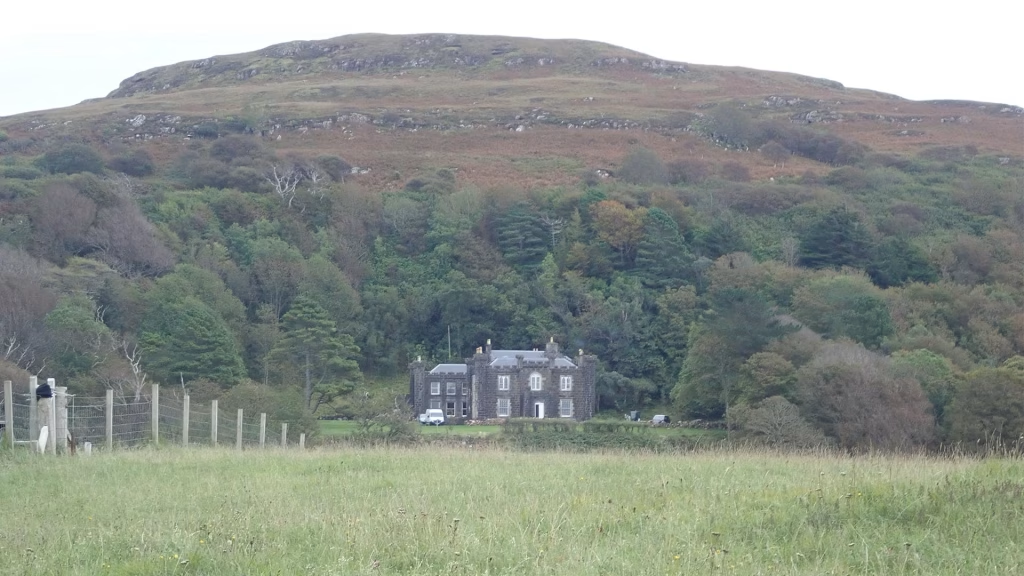
Calgary House, often called Calgary Castle locally, stands above Calgary Bay on the north-west coast of the Isle of Mull. With its crenellated parapets and turreted outline, it is one of the most recognisable historic houses on the island. Despite its castle-like appearance, people never built Calgary House as a fortress. It is a nineteenth-century country house whose history reflects changing patterns of land ownership, wealth, and identity in the Highlands, along with an unexpected connection to the wider world.
The Lands of Calgary Before the House
Long before someone built the present house, small farming communities occupied the lands of Calgary as part of northern Mull’s traditional clan landscape. People worked runrig systems and seasonal grazing, and settlements such as nearby Inivea formed part of a wider network of townships. The name “Calgary” derives from the Gaelic Cala Ghearraidh, commonly translated as “beach of the meadow,” reflecting the fertile ground behind the bay.
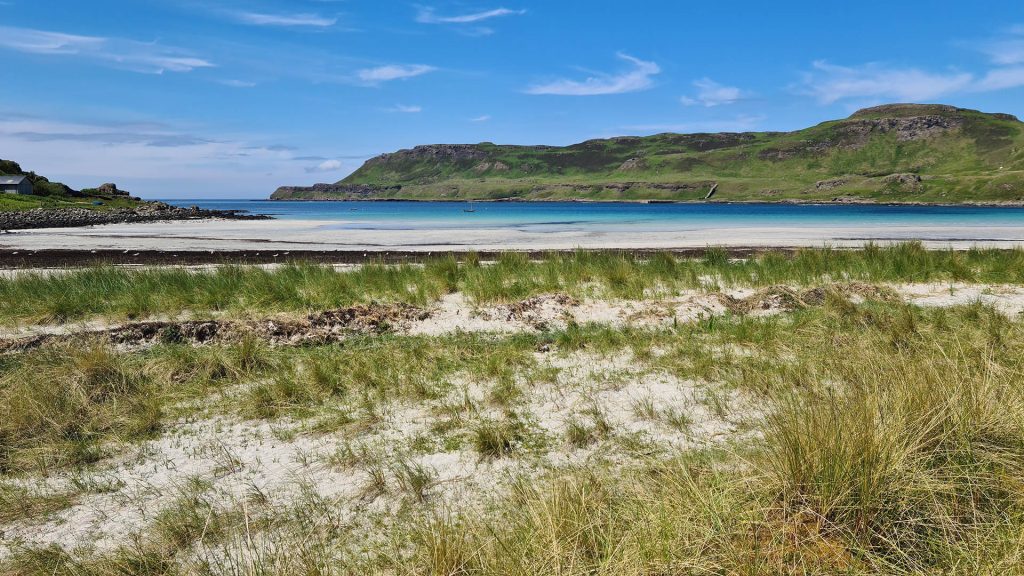
By the late eighteenth century, agricultural reorganisation and estate consolidation began transforming Mull. These changes gradually dismantled older settlement patterns. The clearances in the Calgary area, including the abandonment of Inivea, reshaped both the population and the landscape, preparing the ground for Calgary House.
Before eviction notices were hammered to croft doors and families forced from their ancestral glens, the Isle of Mull thrived on tradition, language, and community. The Mull Clearances: 1846–1856 is a deeply researched, emotionally resonant visual history of the decade that dismantled centuries of Gaelic life.
Building of Calgary House
Captain Alan MacAskill commissioned the present Calgary House in the early nineteenth century, completing most construction by 1823. A prosperous merchant sea captain, MacAskill purchased the Calgary estate in 1817. He was not a clan chief but part of the modernising Highland elite, and the house he built reflected that status.
Instead of constructing a simple laird’s dwelling, MacAskill embraced a romantic Gothic style. He created a castellated mansion with battlements, turrets, and dramatic massing designed to evoke antiquity and authority. This architectural fashion, popular among wealthy landowners, drew on medieval imagery while serving purely domestic and social functions. Calgary House functioned as a statement residence rather than a defensive structure.
Nineteenth-Century Estate Life
Throughout the nineteenth century, the Calgary estate centred on Calgary House. Estate managers collected agricultural rents, oversaw improvements, and conducted daily business from the house. Farmers increasingly worked enclosed fields and grazing land, replacing older communal systems.
Several owners modified the house over time to meet changing needs. By the later nineteenth century, extensions increased accommodation and altered the internal layout, reflecting the expectations of comfort and hospitality common in Victorian country houses.
Life at Calgary House revolved around seasonal rhythms, estate business, and social obligations. While it did not serve as a major political centre, it stood as an important local landmark and symbol of authority in a region adjusting to the aftermath of the Jacobite period and the decline of the clan system.
The Canadian Connection
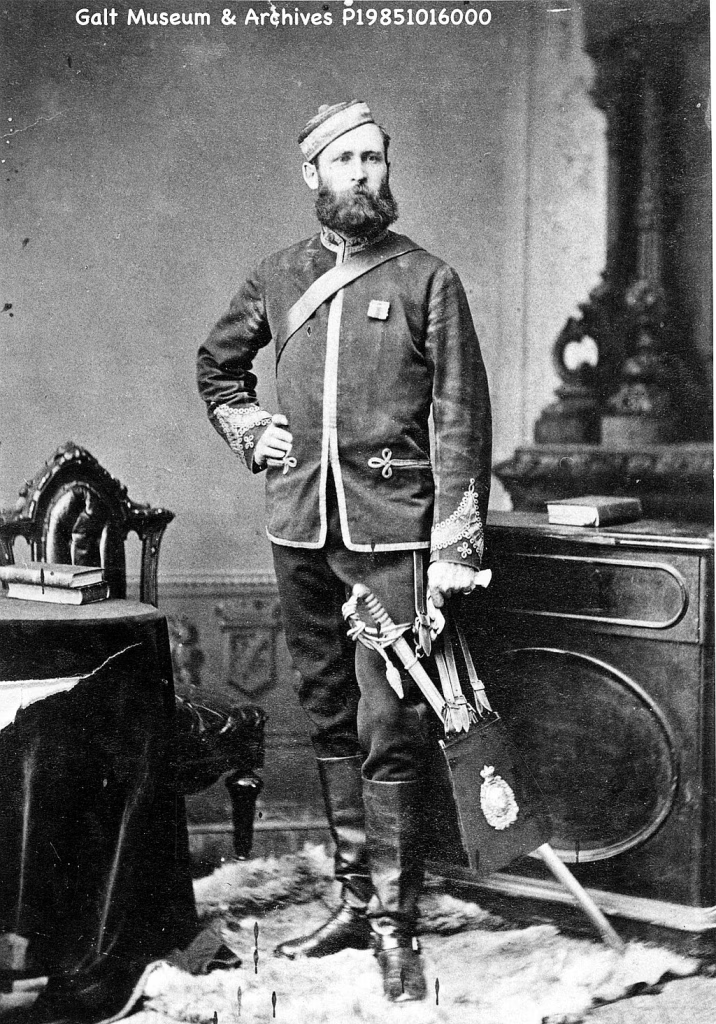
Calgary House has a famous link to Canada. In 1876, Colonel James Macleod of the North-West Mounted Police visited the house while in Scotland. When establishing a new fort in what is now Alberta, Macleod suggested naming it “Calgary,” drawing on his memory of the Mull estate.
The settlement that grew around Fort Calgary eventually became the modern city of Calgary. This connection gives the house significance far beyond Mull, linking a remote Highland estate to the development of western Canada.
Twentieth-Century Changes
Decline of the Estate System
By the twentieth century, the traditional estate system that had sustained large houses like Calgary was in steady decline. Agricultural rents fell, labour costs rose, and new forms of taxation placed increasing pressure on landowners. At the same time, wider social changes weakened the hierarchical estate structures that had defined nineteenth-century Highland life. As a result, large private houses became progressively more difficult to maintain as the administrative centres of working estates.
Transition After the MacAskills
Calgary House reflected these broader shifts in ownership and purpose. After leaving the MacAskill family in the later nineteenth century, the estate was acquired around 1870 by John Munro Mackenzie. His ownership marked a transition away from the house’s original role as the focal point of a newly consolidated estate. While the house remained occupied, estate management became more limited in scope, and Calgary House increasingly functioned as a private residence rather than as the active centre of local authority.
The Mackenzie Period and Landscape Change
The property remained in Mackenzie family ownership into the early decades of the twentieth century. In the mid-twentieth century, Colonel Eric Mackenzie and his wife Elizabeth owned Calgary House. They are particularly associated with reshaping the landscape around the building, planting extensive woodland and ornamental species that transformed the formerly open ground. These plantings softened the surrounding landscape and created the sheltered, wooded setting that characterises the house today.
Later Twentieth-Century Owners
Later in the twentieth century, Calgary House passed into the ownership of Philip Profumo. By this stage, the house no longer played any role in estate administration and was firmly established as a private residence. Its significance lay in its setting, architectural character, and historical associations rather than in control of land or agricultural production.
Towards the end of the century, the house was acquired by Alan Kelsey, who undertook substantial repair and renovation work to ensure its continued use as a modern home. This phase of ownership focused on preservation and adaptation rather than alteration.
Survival Into the Modern Era
Despite periods of uncertainty, the house was never abandoned. Its survival into the twenty-first century reflects a wider pattern among Highland houses, where continuity depended not on traditional estate income but on the willingness of successive private owners to adapt historic buildings to contemporary domestic life. Calgary House retained its distinctive appearance and much of its historic fabric, ensuring its continued presence above Calgary Bay.
Legends, Tales, and Local Memory
Calgary House does not have strong medieval legends or ghost stories because of its relatively recent construction. Local memory, however, preserves quieter narratives. The loss of earlier township communities, the transformation of the land, and the emergence of the estate contribute to a sense of displacement that lingers in the area.
The Canadian naming story dominates tales associated with the house, giving it an almost mythic role in transatlantic history. For many visitors, this connection surprises them, tying a remote Highland bay to a major global city.
Calgary House Today
Today, Calgary House remains a private residence and is not open to the public. Experts recognise it as a building of architectural and historic importance, and it receives appropriate protection. Although often called a “castle,” it is best understood as a nineteenth-century country house designed to project status through romantic architecture rather than military strength.
The house’s dramatic position above Calgary Bay ensures it remains one of Mull’s most photographed and discussed houses, even as it continues quietly within a working landscape shaped by centuries of change.
A House in Context
Calgary House tells a story deeply rooted in Mull’s history. It reflects the decline of traditional settlement, the rise of modern estate ownership, the aesthetic ambitions of the nineteenth century, and the global reach of Highland names and identities. More than just an eye-catching building, it symbolizes how economic forces, cultural shifts, and the movement of people and ideas have shaped Mull far beyond the island’s shores.