

Nestled along the rugged south coast of the Ross of Mull, the Nuns’ Cave, or Uamh nan Cailleach in Gaelic, stands as one of the island’s most intriguing sites. It is a place where natural beauty, history, and local legend blend seamlessly. From its dramatic sandstone cliffs to its mysterious carvings, the cave captures the imagination of anyone who visits. The journey to reach it, with its winding coastal path from Carsaig Pier, is as much a part of the experience as the cave itself, offering sweeping views across the sea and glimpses of the nearby islands.
The cave lies approximately two kilometers southwest of Carsaig, and the route to it passes through some of Mull’s most striking coastal scenery. Hikers encounter steep cliffs, weathered rock formations, and the occasional precarious ledge, making sturdy footwear and careful footing essential. Yet the effort pays off, and as you approach the cave, the cliffs’ towering presence gives way to a wide, welcoming opening carved by centuries of waves.
The Geology of the Nuns’ Cave
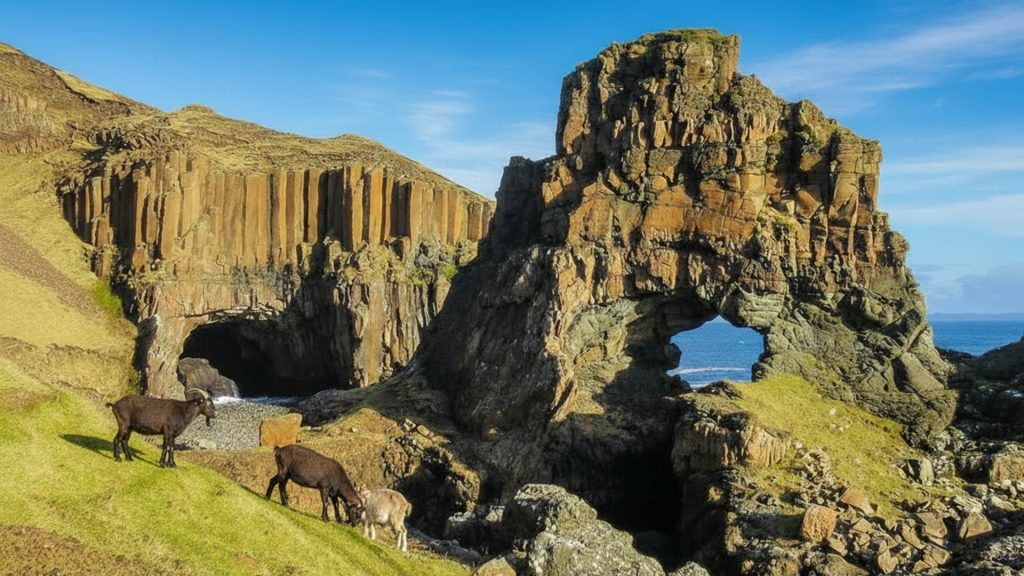
The Nuns’ Cave owes its existence to the relentless work of the sea over thousands of years. The cliffs here are composed of layers of soft sandstone topped with durable basalt columns, a combination that allows the waves to carve deep recesses without undermining the cliffs entirely. The contrast between the warm tones of the sandstone and the dark, jagged basalt above gives the site an almost theatrical appearance.
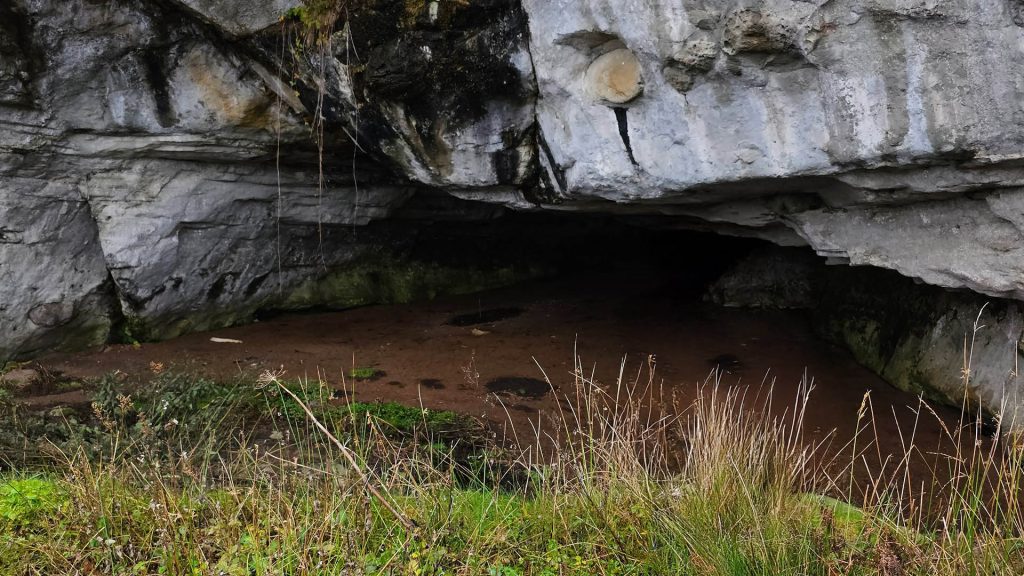
The entrance spans around twenty meters, rising five meters high, and opens into a chamber roughly thirty meters deep. Inside, the walls show clear evidence of erosion, creating textures and grooves that tell the story of the sea’s slow but persistent sculpting. The floor is uneven and covered in goat droppings, as wild goats often shelter in the cave, and several carvings sit unusually close to ground level, suggesting the cave floor has risen over time. Light filters in from the entrance, highlighting the cave’s rough textures and shifting patterns that change with the sun’s movement. Visiting the cave provides an immediate sense of how Mull’s natural landscapes evolve over time, a dynamic interplay between stone, wind, and water.
Early Use and Historical Significance
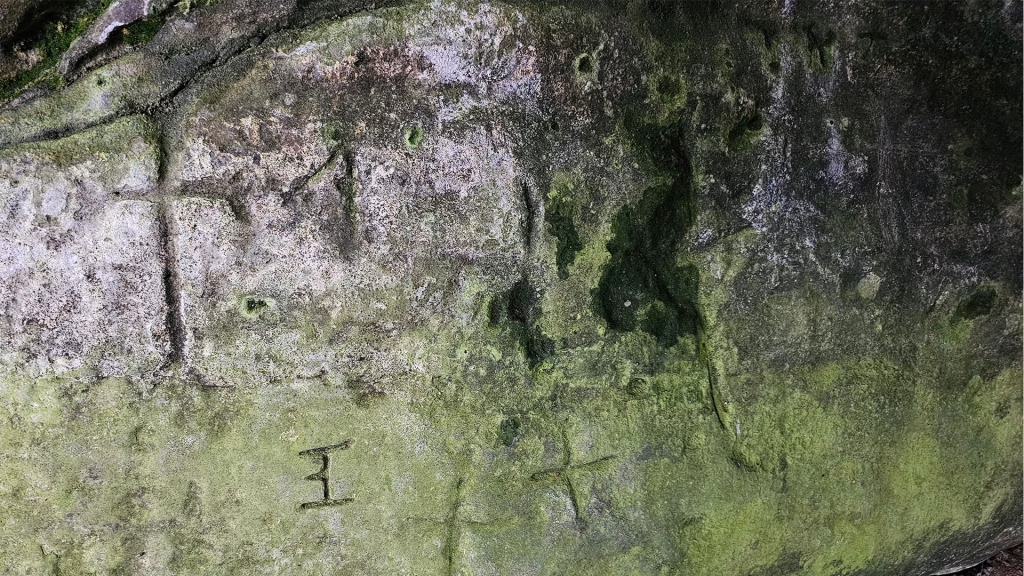
The Nuns’ Cave carries traces of human activity that span centuries. On the west wall, visitors can see an array of carved symbols, some of which date back to the early Christian period. Simple incised crosses suggest that the cave may have served as a quiet retreat for religious communities, possibly linked to Iona, one of Scotland’s most important early Christian centers. Scholars estimate that some of these carvings could be as old as the sixth century.
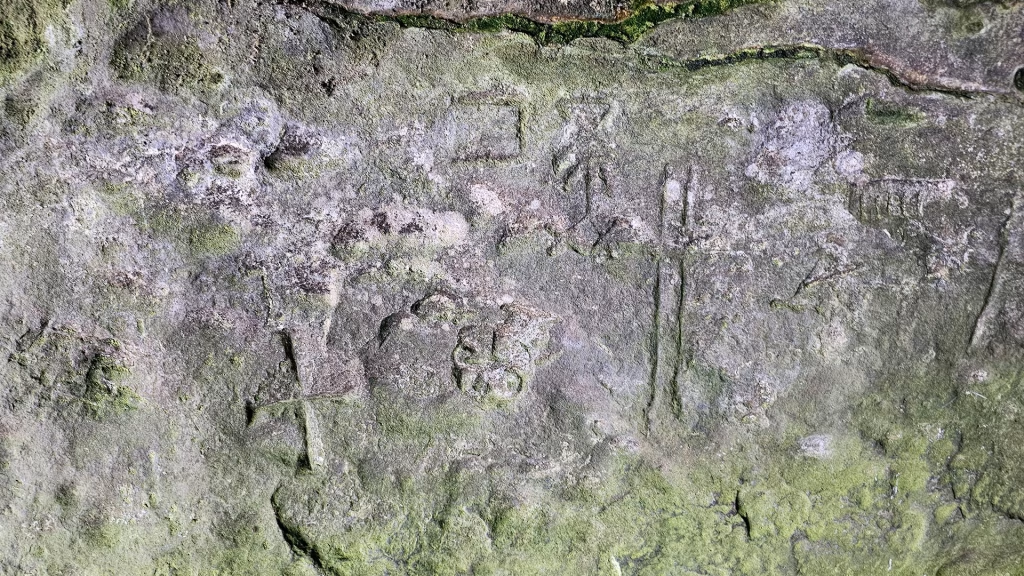
In addition to crosses, the walls display geometric designs and encircled shapes whose purpose remains a matter of speculation. Some might have served protective or commemorative roles, while others may have been artistic expressions by the people who visited the cave over generations. The sheer variety of markings demonstrates that the cave remained relevant for a long time, attracting people who sought shelter, reflection, or a way to leave their mark on the landscape.
Legends and Local Stories
The cave’s popular name, the Nuns’ Cave, is rooted in local legend. Stories claim that nuns from the Iona Nunnery took refuge here during the Scottish Reformation, when monasteries and convents faced suppression across Scotland. The tale suggests that they used the cave as a secret retreat, hiding from authorities until it was safe to return to their religious community. Although historians have not found definitive proof of this, the legend endures, adding a layer of mystery that draws visitors and storytellers alike.
The Gaelic name, Uamh nan Cailleach, translates roughly as “Cave of the Old Woman” or “Cave of the Hag.” Some historians believe this may originally refer to mythological or spiritual figures from local folklore. Over time, the nuns’ story became intertwined with the site, blending legend with the natural and historical significance of the cave. Today, both names are used interchangeably, reflecting the rich layers of meaning attached to this singular place.
Carvings and Marks
One of the cave’s most remarkable features is its extensive collection of carvings. Beyond early Christian crosses, the walls bear the marks of masons and quarry workers from later centuries. A carved sailing ship, thought to date from the eighteenth or nineteenth century, hints at the practical use of the cave as a shelter for those working in nearby sandstone quarries. Some of these stones were used in building projects on Iona, including its historic nunnery, linking the cave to wider architectural history.
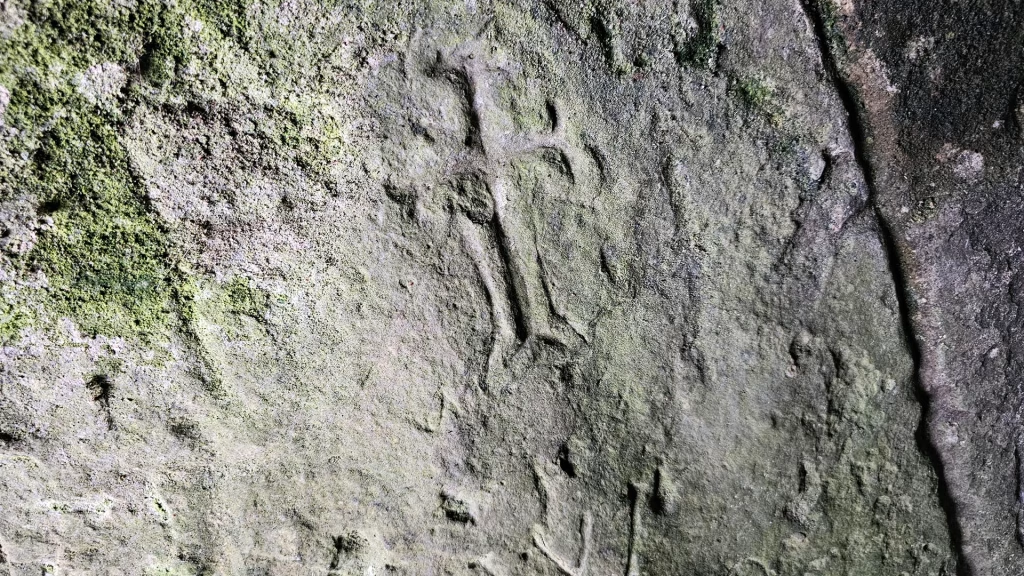
Visitors will also notice more recent graffiti and initials carved into the rock, a testament to the cave’s enduring appeal as a site people want to leave their mark on. These layers of carvings tell a continuous story of human interaction, from spiritual devotion to everyday labor and curiosity. The cave stands as a living record, blending art, history, and personal expression across the centuries.
Quarrying and Local Industry
The cliffs surrounding the Nuns’ Cave were once a significant site for sandstone quarrying. In front of the cave is a flat platform of hard, grey sandstone, now covered at high tide, which served as a working area for splitting stone. Quarry workers used wooden wedges driven into cracks in the rock; the wedges would expand when wetted by the tide, forcing the slabs apart. Stone from this site is believed to have been used for the carved ornamental work at Iona Abbey, for grave slabs for chiefs and dignitaries, and for doors and window facings across Mull. Quarrying activity continued here until shortly before the mid-19th century and was briefly reopened in 1875 for restoration work at Iona Abbey.
Workers often sought shelter in the cave itself, leaving marks and carvings that record their presence and daily lives. The combination of natural beauty and practical use illustrates the cave’s dual significance, showing that it was never simply a scenic feature but also a meaningful part of Mull’s economic and cultural landscape.
Visiting the Nuns’ Cave
Visiting the Nuns’ Cave requires preparation, but the experience rewards those who make the journey. The walk from Carsaig Pier winds along cliffs and across uneven terrain, offering glimpses of sea stacks, rock arches, and distant islands. Hikers should wear sturdy shoes and exercise caution near cliff edges. Checking tides before setting out is essential, as some parts of the path become slippery or submerged during high tide.
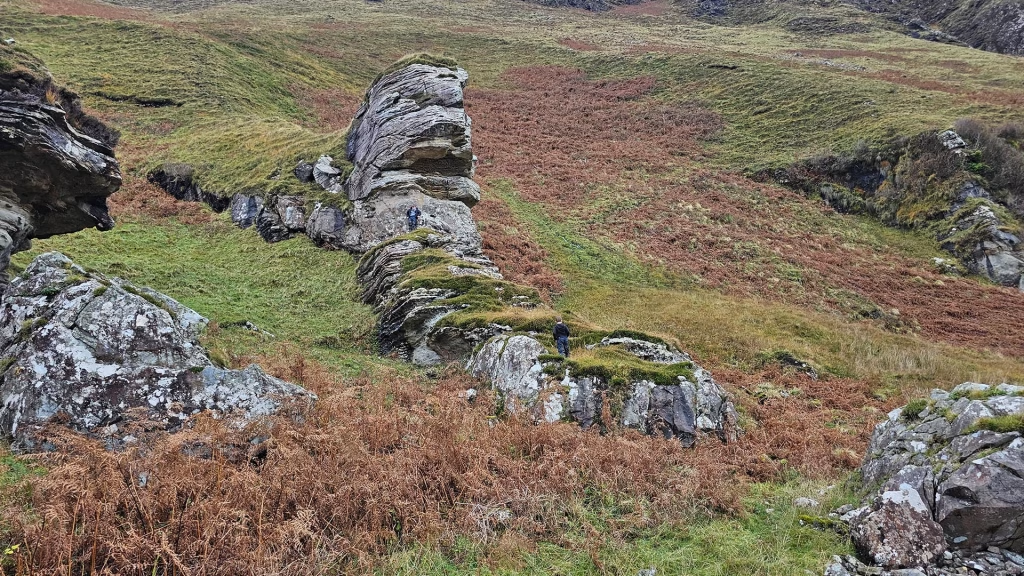
Approaching the cave, hikers will pass the steep and exposed Nun’s Pass, while the unusual Sphinx-like rock below the path provides a striking landmark along the shore.
The journey to the cave can easily be combined with a visit to the nearby Carsaig Arches, another geological marvel carved by the sea. Together, these sites provide a full day of exploration along Mull’s southern coast. The effort involved in reaching the cave enhances the sense of discovery and allows visitors to fully appreciate its isolation, natural beauty, and historical resonance.
Cultural and Educational Value
The Nuns’ Cave offers a rare combination of natural wonder and cultural insight. Archaeologists and historians study its carvings to better understand early Christian practices, local folklore, and quarrying activity. The site provides tangible evidence of how people interacted with their environment over centuries, from religious reflection to practical labor. For educators, the cave serves as a living classroom, where history, geology, and mythology intersect.
Guided walks and educational programs often highlight the significance of the carvings, explaining their meaning and context. They also explore the legends surrounding the nuns and local folklore, giving visitors a richer sense of the cave’s story. Whether approached from a historical, geological, or cultural perspective, the Nuns’ Cave invites curiosity and reflection, making it a memorable highlight of any visit to Mull.
Conservation and Preservation
Protecting the Nuns’ Cave is crucial to preserving its historical and natural features. The carvings remain vulnerable to weathering and human interference, so visitors must exercise care. Local heritage organisations monitor the site and provide guidance to ensure that the cave remains intact for future generations.
Preservation efforts focus on maintaining the cave’s integrity while allowing responsible access. Informational signage and guided tours help visitors understand its significance, encouraging respect for both its natural and cultural aspects. By balancing access and conservation, the Nuns’ Cave can continue to educate and inspire while remaining a cherished landmark of Mull.
The Nuns’ Cave Today
Today, the Nuns’ Cave draws hikers, history enthusiasts, and photographers, all eager to explore its dramatic setting and storied walls. Its mix of natural beauty, human history, and legend gives it a unique appeal. Visitors often spend time simply sitting near the entrance, listening to the waves, and imagining the centuries of people who once sought shelter there.
The cave exemplifies how a single location can hold multiple layers of significance. It connects geology with human activity, blends folklore with historical fact, and offers both adventure and reflection. For those exploring Mull, it provides a sense of continuity between past and present, nature and culture, legend and lived experience.
Experience the Nuns’ Cave
The Nuns’ Cave on the Isle of Mull offers far more than a dramatic coastal view. It is a place where natural forces, human history, and legend converge. From its carved walls to its links with quarrying and early Christian traditions, the cave tells a story that spans centuries.
Visiting the Nuns’ Cave allows you to step into that story, to trace the paths of those who came before, and to experience a part of Mull that remains wild, beautiful, and deeply intriguing. It is a reminder that even in remote corners, history leaves its mark, and nature continues to shape the land. For anyone exploring the southern coast of the island, the Nuns’ Cave promises both discovery and reflection, offering an unforgettable glimpse into the heart of Mull.