
Discover the fascinating history of the Isle of Mull through the eyes of the many historical visitors to Mull who have walked its rugged shores. From ancient Roman cartographers and early Christian saints to pioneering Victorian scientists and world-renowned Romantic poets, Mull and its neighboring isles of Iona, Staffa, and Ulva have long been a magnet for those seeking inspiration, adventure, and discovery.
This guide explores the diverse range of famous people who traveled to the Hebrides, offering a deep dive into the lives of notable historical visitors to Mull. Whether they were mapping the unknown world, composing masterpieces inside Fingal’s Cave, or tracing their ancestral roots, these travelers left an indelible mark on the island’s cultural heritage. Read on to learn about the writers, explorers, and royalty who rank among the most important historical visitors to Mull and helped put this iconic Scottish island on the world map.
Ancient and Early Travelers
Ptolemy (2nd Century AD)
Living in the second century, this famous Roman mathematician and geographer included the islands in his world maps. He referred to the group as the Ebouda. While his maps had some famous errors, such as tilting Scotland the wrong way, he provided the earliest written record of the islands’ existence in the classical world.

St Columba (563 AD)
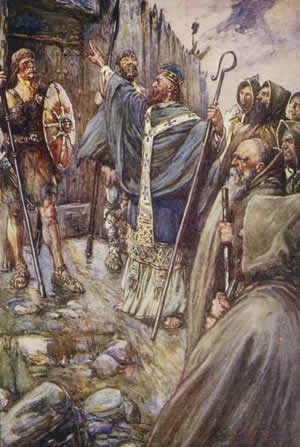
In the year 563, Columba left Ireland and arrived on Iona, just off the coast of Mull. He chose the spot because it was the first place he landed where he could no longer see his homeland. He founded a monastery that became a massive center for learning and religion, effectively bringing Christianity to much of Scotland.
Sir Donald Munro (1549)
Known as the High Dean of the Isles, Munro traveled through the Hebrides in 1549. He acted as the eyes and ears of the Bishop, writing down some of the first detailed descriptions of the landscapes and local residents of Mull, Gometra, and Calve Island during the mid-sixteenth century.
Explorers of the 1700s
Martin Martin (1695)
A graduate of the University of Edinburgh and a native of Skye, Martin Martin visited Mull in 1695 to document the unique culture of the Hebrides. He published his findings in the landmark book, A Description of the Western Isles of Scotland (1703). This work provided the first detailed look at 17th-century island life, including local traditions, diet, and social structures. His writing was so influential that both Dr. Samuel Johnson and James Boswell carried a copy with them as their primary guidebook during their own journey nearly eighty years later.
One of the greatest travellers in Scotland, Martin Martin was also a native Gaelic speaker. This text offers his narrative of his journey around the Western Isles, and a mine of information on custom, tradition and life. Martin Martin's wrote before the Jacobite rebellions changed the way of life of the Highlander irrevocably.
The volume includes the earliest account of St Kilda, first published in 1697 and Sir Donald Monro, High Dean of the Isles, account written in 1549 which presents a record of a pastoral visit to islands still coping with the aftermath of the fall of the Lords of the Isles.

William Sacheverell (1702)
This Member of Parliament visited Iona and Mull in 1702. He is best remembered for his obsession with the Spanish galleon that exploded and sank in Tobermory Bay. He spent significant time and effort trying to recover the legendary lost treasure from the wreckage on the seabed.
Thomas Pennant and John Lightfoot (1771)
Thomas Pennant, a noted Welsh naturalist, toured Mull alongside the botanist Reverend John Lightfoot. Pennant published their findings in his famous work, A Tour in Scotland and Voyage to the Hebrides 1772, which helped popularize the island as a destination for scientific study. Lightfoot’s specific research during this trip led to the publication of Flora Scotica (1777), the first systematic and scientific catalog of the plants and fungi found on Mull and the surrounding islands, marking a major milestone in Scottish natural history.

Sir Joseph Banks (1772)
The famous naturalist visited Staffa in 1772 and brought the island to world fame. During his stay, he spent a night in a local hut. The next morning, he found he was covered in lice. When he mentioned this to his host, the man became very angry and claimed that Banks must have brought the bugs with him from England.

Dr. Samuel Johnson and James Boswell (1773)
This famous pair arrived in 1773 and stayed at Erray House in Tobermory. They also visited the Laird of Lochbuie, who was a very proud man. The Laird caused a bit of a scene when he asked if Johnson was a member of a local Highland family. Boswell had to step in and explain that Johnson was actually an Englishman.

Romantic Artists and Writers
Felix Mendelssohn (1829)
The German composer visited Tobermory and Staffa in 1829. Even though he suffered from terrible seasickness during the boat trip, the sight of the basalt columns inside Fingal’s Cave moved him deeply. He sent a postcard to his sister with the first notes of his famous Hebrides Overture written on it.

Sir Walter Scott (1814 and 1831)
The legendary Scottish novelist visited twice. His voyages around the coast of Mull provided the direct inspiration for his poem, The Lord of the Isles. He described the islands as more extraordinary than any description he had ever heard, and his writing helped bring thousands of early tourists to the area.

J.M.W. Turner (1831)
The famous landscape painter traveled through the Sound of Mull to reach Staffa. He was there to make drawings for Sir Walter Scott’s books. His sketches of the wild sea and the dark caves later became some of his most famous oil paintings, showing the world the raw power of the local landscape.

John Keats (1818)
The poet John Keats walked across Mull in 1818. It was a very difficult journey during a wet summer. He had to wade through deep bogs and sleep in tiny shepherd’s huts. He wrote to his brother about how exhausting the walk was, but he was still amazed by the size of the mountains and the sea.

William Wordsworth (1833)
The famous poet visited the islands later in his life. He wrote several poems about the scenery, though he complained in his writing that there were too many other tourists around. He felt that the crowd of people at Fingal’s Cave made it harder to enjoy the quiet beauty of the place.

Notable 19th Century Figures
Sir Lachlan Macquarie (1762 to 1824)
Born on the Isle of Ulva, Macquarie rose to become the Governor of New South Wales. He is known as the Father of Australia. After his long career abroad, he returned to his estate on Mull to spend his final years. His tomb at Gruline is still a place of historical importance for many visitors today.

John MacCulloch (1811 to 1821)
This geologist made several trips to Mull to study the rocks. He is most famous for finding a forty million year old tree that had been turned to stone by lava. This famous site is still known as MacCulloch’s Tree and can be found on the wild coastline of the Ardmeanach peninsula.

David Livingstone (1864)
The world-renowned explorer of Africa visited Ulva in 1864. He came to search for the home of his grandfather, who had been forced to leave the island years earlier. It was his only visit to his ancestral home, and he spent his time looking for any trace of his family history among the old ruins.

Queen Victoria (1847)
The Queen visited Tobermory and Staffa in 1847. She traveled on the royal yacht and wrote in her diary about how much she enjoyed the islands. Her visit was a major event for the local people and helped make Mull a very popular place for wealthy Victorian travelers to visit.

Robert Louis Stevenson (1870)
The author of Treasure Island stayed on the Isle of Erraid while his family was building a lighthouse. He used his time there to learn about the dangerous rocks and local stories. He later used Erraid as the setting for the famous shipwreck in his popular novel, Kidnapped.