

Wind scours the Treshnish coast. If you walk along the cliffs on the northwest side of Mull today, you see a beautiful, empty landscape. It is quiet now, yet two hundred years ago, this silence was a deception.
Hidden below these cliffs lies the Whisky Cave. Local stories have long identified this spot as a secret factory for illicit spirits. While we must separate folklore from hard fact, the site remains a powerful connection to a difficult chapter in Highland history.

The Real History of Smuggling
To understand the cave, you must look at the laws of the 18th and 19th centuries. The British government desperately needed money for wars, so they imposed heavy taxes on malt and spirits. Furthermore, they banned the small stills that farmers had used for generations.
This policy devastated the people living on Mull. Barley was their main crop, but the wet Hebridean climate often caused the grain to rot before winter ended. Distilling offered a solution. By turning surplus grain into whisky, crofters created a product that would not spoil and could be sold for cash.
Consequently, when the government banned the practice, the locals did not stop. Instead, they moved their operations out of sight. They became “smugglers” to survive. The families in the nearby townships of Crackaig and Glac Gugairidh needed to pay their rent, and illicit distilling provided the means to keep their homes.
The Cave and the Landscape
The cave sits in a deep inlet, or “geo,” which makes it nearly invisible from the cliff tops. Anyone walking along the grass edge above would struggle to spot the entrance.

A large mound of earth and rock dominates the cave mouth. Guidebooks often claim the distillers built this wall to hide their firelight. However, the archaeological record is less certain. Nature may have created this barrier through rockfalls.
Regardless of its origin, the mound served a vital purpose. It blocks the view from the open sea. In the days of the Excisemen, patrols often approached by boat. The mound screened any fire burning inside, while the smoke filtered through the rocks to mix invisibly with the sea spray.
Inside the Cave
If you scramble down the steep slope today, you can walk right inside. Unlike many damp sea caves, this cavern remains largely dry.
Moreover, the back of the cave features a crucial natural resource. Fresh water drips from the rock wall. Distillers needed this constant supply of cold water to cool the worm tub, which condenses alcohol vapor back into liquid. This natural spring turned a simple shelter into a viable industrial site.
On the floor, you will find leveled stone formations. Some writers confidently label these as foundations for stills or mash tuns. In reality, we cannot be certain without a formal excavation. Nevertheless, these stones sit in the perfect spot for such work, and they likely represent the remains of the workspace that the smugglers left behind.

The People of the Cliffs
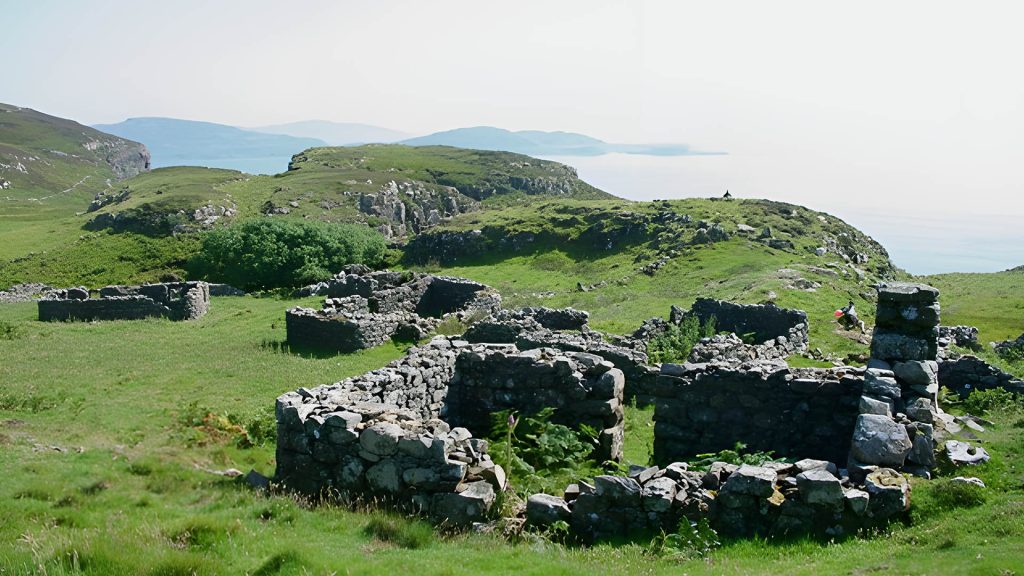
The history of the cave connects directly to the ruins above. The township of Crackaig sits on the shelf of land overlooking the sea, where the stone walls of cottages and barns still stand.
These villagers likely operated the cave. Records indicate that Crackaig was once a substantial settlement where people fished, farmed, and almost certainly distilled spirits to supplement their income.
Meanwhile, Excisemen patrolled the area constantly. Records show they seized equipment and issued fines across Mull during this era. The risk of discovery was high. If an agent found a still, he would destroy it and fine the family into ruin. This danger explains why locals carried heavy equipment down such a treacherous cliff. The cave offered a safety that the village could not provide.
The End of an Era
Eventually, the illicit industry on this coast faded away. The end did not come from a dramatic police raid, but through a slow decline in population.
The 19th century brought the Highland Clearances to Mull. Landlords removed tenants to make way for sheep farming, which slowly emptied the villages of Crackaig and Glac Gugairidh. Census records from the late 1800s show the population dropping until the houses stood empty.
When the people left, the cave lost its purpose. With no one to scramble down the cliffs and no barley to malt, the fire went out.
Before eviction notices were hammered to croft doors and families forced from their ancestral glens, the Isle of Mull thrived on tradition, language, and community. The Mull Clearances: 1846–1856 is a deeply researched, emotionally resonant visual history of the decade that dismantled centuries of Gaelic life.
Visiting the Site Today
Today, the Whisky Cave offers a quiet reflection on the past. It is not a museum with ticket booths, but a rocky shelter on a wild coast.
Getting there requires effort. The path is narrow, and the final descent is steep, grassy, and potentially dangerous when wet. This difficulty reminds you of the physical labor the smugglers endured.
When you stand inside, you see a space that has changed little in two centuries. Fresh water still drips from the wall, and the mound still blocks the wind. You do not need invented stories about buried treasure to appreciate this place. It stands as a silent monument to the resilience of ordinary people who worked hard to survive on the edge of the world.