

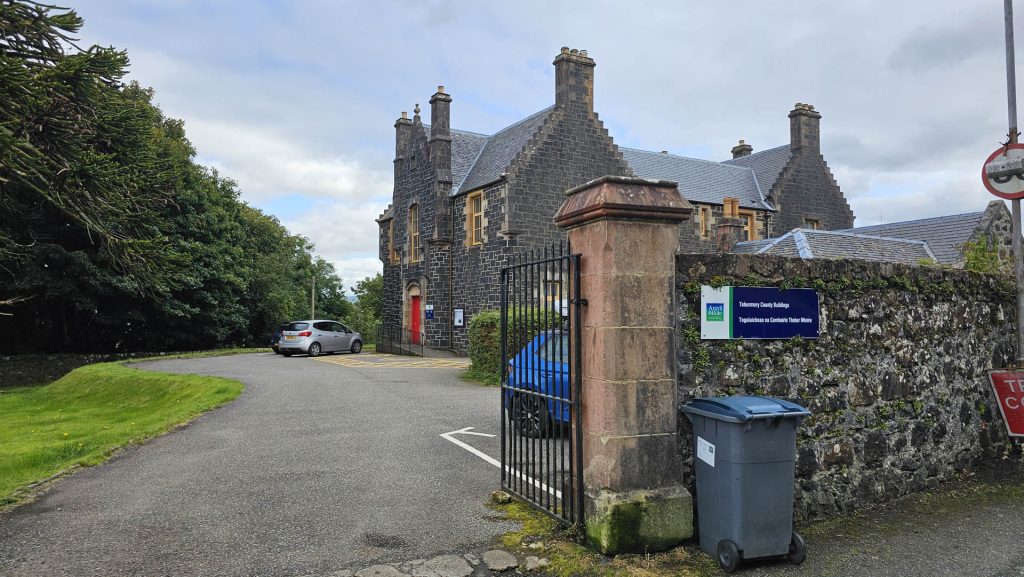
Perched above Tobermory Harbour on Breadalbane Street, the County Buildings form one of the Isle of Mull’s most important historic structures. Built in the mid-19th century as a combined court house and prison, the building played a central role in administering justice and local governance. Today, it remains a striking part of the townscape, reminding visitors of Tobermory’s history beyond its colourful waterfront.
A Civic Centre for Mull
Tobermory began in 1788 as a planned fishing and trading port. By the mid-1800s, the town had grown into the main settlement on the island, serving as a hub for commerce, administration, and law. As the population increased, locals recognized the need for a proper court house.
In 1861 (Canmore 157762, reference AGD/29/2), the Edinburgh architects John Dick Peddie and Charles Kinnear began work on a building that served both as a court house and a small prison. Their design combined functionality with authority. The County Buildings offered a visible statement of law and civic responsibility.
Architectural Features
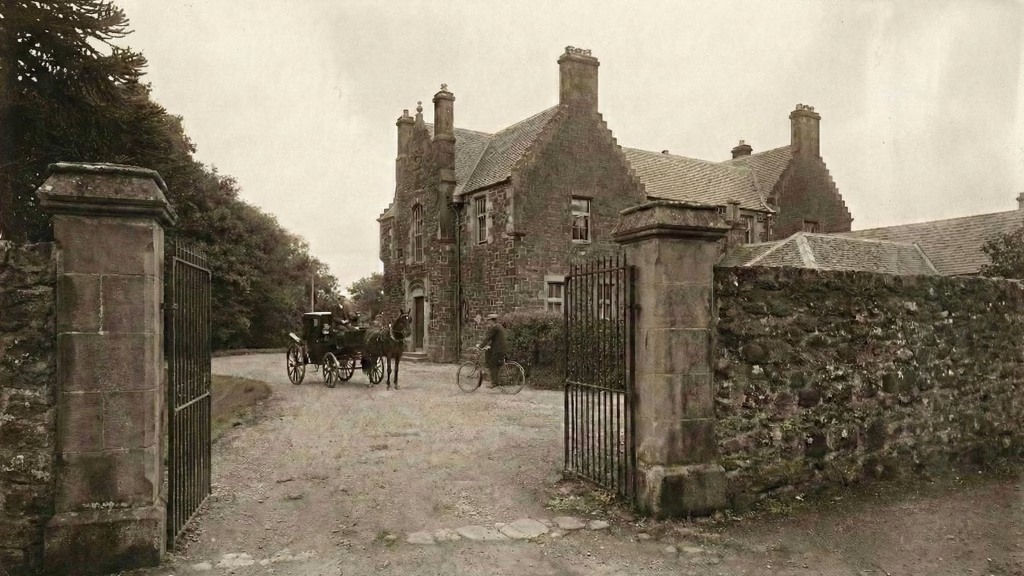
The County Buildings rise two storeys and span three bays, constructed from squared and snecked rubble with ashlar dressings. The restrained Scots Baronial style gives the building its historic character. Crow-stepped gables, corbelled corners, and timber sash and case windows enhance its distinctive appearance while remaining practical for its function.
Sitting on high ground, the building overlooks Breadalbane Street and the harbour, giving it a commanding presence in the town. Boundary walls and gatepiers complement its formal appearance, making the structure instantly recognizable as a civic landmark.
Dual Purpose: Court House and Prison
The architects designed the County Buildings for dual use. The courtroom on the first floor hosted sheriff court proceedings, handling civil and criminal cases for Tobermory and surrounding island communities. The ground floor contained a small prison with holding cells, which officials used to securely detain offenders awaiting trial or sentencing.
This combination made the building the centre of legal authority on Mull. Officials, lawyers, witnesses, and defendants traveled from across the island, reinforcing Tobermory’s role as the administrative hub for northern Mull.
Inside the Building
Although renovations changed parts of the interior over time, the courtroom retains timber panelling and a cast-iron fireplace, giving visitors a glimpse of its 19th-century origins. While the prison spaces have changed, the building still conveys a strong sense of its original purpose as a place of law and order.
Changing Times
By the early 20th century, small local prisons like Tobermory’s became obsolete, and Scotland reorganized court provision. The sheriff court closed in 1905. The local authority repurposed the building for civic use, adapting it to new functions while preserving its character.
The former courtroom became a registry office, and the rest of the building continued to host public services. This adaptability ensured the building’s preservation and ongoing importance to the community.
Listed Status
The County Buildings earned Category C listed status in 1971, recognising their architectural and historical importance at a local level. The listing covers the building, its boundary walls, and gatepiers. An amendment in 2017 reaffirmed its significance, guaranteeing that its unique character will endure for future generations.
The Building in Tobermory Today
Visitors notice the County Buildings immediately because of their elevated position above the harbour and striking architectural presence. While most people visit Tobermory for the colourful waterfront, local shops, and ferry connections, the County Buildings reveal the town’s civic history. They show that Tobermory has long been more than a picturesque harbour. It has served as a centre of governance, law, and community life.
Walking past the building, it is easy to imagine 19th-century court days, with officials arriving by boat or cart, witnesses coming from across the island, and civic life bustling around the courthouse. The building’s survival and continued use make it a tangible link to Mull’s past.
A Testament to Civic Architecture
The County Buildings illustrate mid-19th-century Scottish civic architecture. They combine practicality with style, showing the authority and seriousness of their original purpose while integrating smoothly into the town’s streetscape. Unlike many buildings of the era, they continue to serve public functions, ensuring their preservation and relevance.
For anyone interested in Mull’s history, the County Buildings offer a chance to see the island’s legal and administrative past up close. From their commanding position above Breadalbane Street to the surviving courtroom features, they remind visitors of the role law, order, and civic pride played in shaping Tobermory.