



The waters around the Isle of Mull and surrounding Hebridean islands boast a rich maritime history. From Spanish Armada galleons to 20th-century cargo vessels, these wrecks tell vivid stories of trade, war, and disaster. Consequently, the following list highlights some of the most significant wrecks around Mull, organized in chronological order.

Tobermory Galleon (1588)
Local legends identify the Tobermory Galleon as a Spanish Armada ship, likely an armed merchantman, which sought refuge in Tobermory Bay in 1588. During a tense standoff, the vessel exploded and sank, creating one of Mull’s most enduring maritime mysteries.
Over the years, divers and salvagers have recovered artefacts such as anchors, cannon, and other debris believed to be from the ship. While the full wreck has never been located and no treasure has been found, these remnants provide a tangible link to 16th‑century naval history. The story continues to captivate historians and maritime enthusiasts alike, keeping the mystery of the Tobermory Galleon alive
Location: Tobermory Bay, Isle of Mull (approx. 56.62047 N, –6.06052 W)

HMS Dartmouth (1690)
HMS Dartmouth, a Royal Navy fifth-rate frigate, sank during a fierce storm in 1690 while operating against the Jacobites. The ship went down off Eilean Rubha an Ridire, tragically taking most of her crew with her. At present, her remains include structural timbers and ballast stones, marking her as one of the oldest Royal Navy wrecks in Scottish waters.
Since the site is protected, it offers unique archaeological insights into 17th-century naval shipbuilding. Consequently, divers must respect the strict regulations governing the area.
Location: Eilean Rubha an Ridire, Isle of Mull (approx. 56.50300 N, –5.70024 W)

Guy Mannering (1865)
In 1865, the merchant clipper Guy Mannering ran aground on Brown’s Rock near Iona during a heavy storm. She carried a general cargo and exemplified the fast trading vessels of the 19th century. Although the sea has reclaimed much of the ship, fragments of her hull and iron fittings still remain on the seabed.
As a result, the site provides a dramatic dive and a glimpse into mid-19th-century maritime commerce. Moreover, the proximity to Iona makes it an easily accessible location for local charters.
Location: Brown’s Rock near Iona (approx. 56.32546 N, –6.42891 W)
Graf Von Schliefen (1868)
The German barque Graf Von Schliefen struck Sgeir Ruadh in the Sound of Iona in 1868. This large, three-masted sailing vessel carried bulk cargoes before treacherous weather caused its loss. Meanwhile, modern divers can still find scattered ironwork and remnants of her fittings among the reefs.
Historically, the wreck remains a significant example of 19th-century merchant shipping hazards. Additionally, the surrounding reefs support a diverse range of marine flora.
Location: Sound of Iona (approx. 56.31366 N, –6.40650 W)
Minnie Knapp (1881)
The Minnie Knapp, a small coastal steamship, met its end near Mull in 1881. A sudden storm overwhelmed the vessel while she carried general cargo, causing her to founder. Although researchers have not confirmed the exact site, the ship remains a vital part of Mull’s record regarding early steam navigation risks. Specifically, it highlights the vulnerability of small steamers in the Inner Hebrides.
Location: Iona, Inner Hebrides (approx. 56.3229° N, –6.4265° W)
John Preston (1882)
In 1882, the cargo steamer John Preston sank near Rubha Dearg after striking submerged rocks. Fortunately, most of the crew survived the accident, though the sea claimed the ship itself. The wreck now lies in shallow water, where divers can see visible hull plates and fittings.
Furthermore, the site demonstrates the constant dangers that early steam-powered cargo vessels faced when navigating Hebridean waters. Due to its shallow depth, it serves as an excellent site for underwater photography.
Location: Rubha Dearg, Isle of Mull (approx. 56.53305 N, –5.80362 W)
Thesis (1889)
While carrying pig iron in 1889, the small cargo steamer Thesis struck rocks near Rubha an Ridire. The ship sank quickly, yet the crew managed to escape safely to the shore. Today, divers explore her remains in shallow water, finding iron cargo, boilers, and structural components.
These artifacts offer valuable insight into the design of late-19th-century merchant steamers. Similarly, the site provides a look at how heavy iron cargo impacts the resting position of a vessel.
Location: Rubha an Ridire, Isle of Mull (approx. 56.50033 N, –5.69159 W)
Pelican (1895)
The small cargo steamer Pelican ran aground on Calve Island in Tobermory Bay in 1895. Historically, salvors recovered some of her cargo and fittings shortly after the incident. Divers today can explore the scattered remains along the shoreline, which makes it a convenient wreck dive within Tobermory Bay. Consequently, it is often used as a second dive site on local trips.
Location: Calve Island, Tobermory Bay (approx. 56.61467 N, –6.04277 W)
Cathcartpark (1912)
In 1912, the cargo steamer Cathcartpark struck rocks and sank near Soa Island while transporting general cargo. Scattered hull remains and cargo remnants provide insight into early 20th-century coastal trading vessels. Furthermore, the accessible nature of the site makes it a popular point of interest for local divers. In addition to the wreck, the area is known for its curious seals.
Location: Passage of Tiree, near Soa Island (approx. 56.28590 N, –6.45343 W)
Shuna (1913)
In 1913, the 1,000-ton cargo steamer Shuna sank in the Sound of Mull after a collision while carrying coal and other goods. Her wreck lies upright and remains largely intact on the seabed. Consequently, the site offers one of the area’s most accessible dives, featuring abundant marine life around the structure. Because it sits at a manageable depth, it is a favorite for many recreational divers.
Location: Sound of Mull, near Shuna Island (approx. 56.55648 N, –5.91440 W)
General Consul (1914)
The merchant steamer General Consul vanished near Mull in 1914. Although limited records exist regarding her final moments, she represents a significant loss during the early 20th century. Since researchers have not fully surveyed the wreck site, she remains one of Mull’s lesser-known maritime mysteries. Specifically, the exact location of the main boiler is still a topic of debate.
Location: Exact coordinates unknown
Aurania (1916)
During World War I, the Cunard Line used the RMS Aurania as a troopship. In 1918, a German submarine torpedoed her off the northwest coast of Ireland. Although the crew attempted to tow her, she eventually grounded near Tobermory and broke apart. Today, the submerged wreck serves as a dramatic example of the maritime hazards faced during the First World War. Moreover, the scale of the debris field is immense.
Location: Near Tobermory, Isle of Mull (approx. 56.60237 N, –6.32508 W)
Arnold (1925)
In 1925, rough seas drove the small coastal cargo vessel Arnold onto rocks off Soa Island near Coll. The wreckage remains scattered and partially broken across the seabed. Ultimately, this site illustrates the significant hazards of navigating the Hebrides’ rocky coastline during the early 20th century. For this reason, the area is frequently cited in nautical safety guides.
Location: Near Soa Island, Coll (approx. 56.56405 N, –6.65105 W)
Rondo (1935)
In 1935, a severe storm sank the cargo steamer Rondo after she ran aground on Dearg Sgeir. The vessel broke up as her stern hit the rocks, though fortunately, the crew survived the ordeal. Currently, parts of her hull remain on the rocks and underwater, creating a challenging site for experienced divers. Furthermore, the vertical orientation of the wreck makes it a unique diving experience.
Location: Dearg Sgeir, near Mull (approx. 56.53843 N, –5.91248 W)
Buitenzorg (1941)
In 1941, the Dutch freighter Buitenzorg grounded on reefs in the Sound of Mull while carrying general cargo. Her loss clearly illustrates the dangers that merchant shipping faced during World War II. Specifically, her scattered remains attract divers and maritime historians who study wartime shipping losses in the Hebrides. Additionally, many of the ship’s small artifacts were salvaged by locals at the time.
Location: Sound of Mull (approx. 56.50473 N, –5.74127 W)
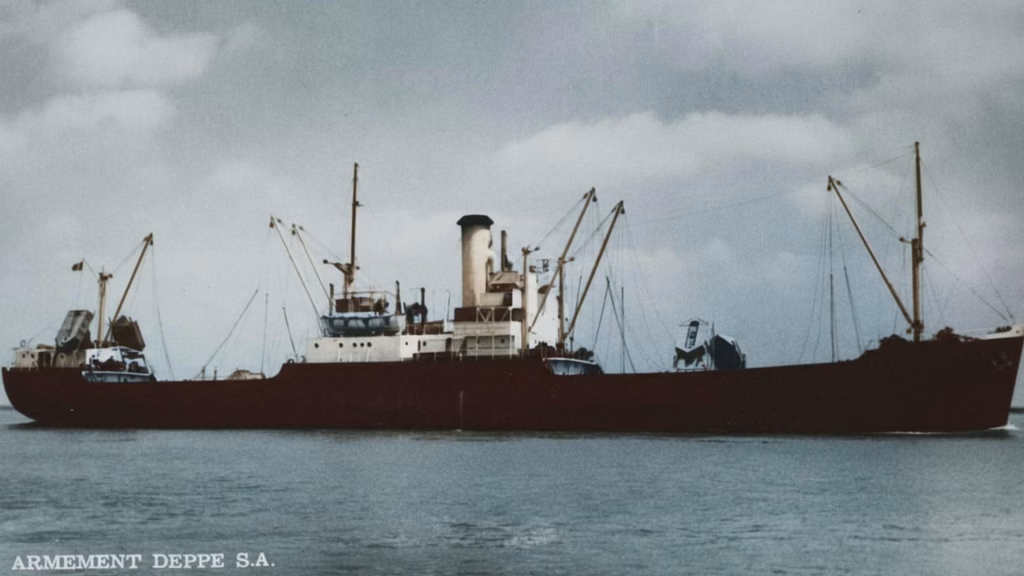
Ostende (1943)
During World War II, the Allies pressed the Belgian cargo steamship Ostende into service. On 17 January 1943, an explosion in her bow forced the captain to beach her in Loch na Làthaich to prevent a total sinking. A few days later, a fire triggered catastrophic explosions that destroyed most of the vessel and killed two seafarers. Because of the danger, the site was cordoned off for years.
Although workers extensively salvaged the wreck after the war, substantial remains still lie off the old Bendoran Boatyard. The site remains popular for training, yet divers must exercise caution due to reports of occasional unexploded ordnance. Consequently, the local authorities still monitor the area for safety.
Location: Loch na Làthaich, near Bunessan (approx. 56.32143 N, –6.26655 W)
Angela (1953)
The small merchant vessel Angela disappeared near Mull in 1953. While historians have recorded little about her final voyage, she represents one of several post-war wrecks in the region. Currently, the wreck remains one of the more obscure and unidentified sites around the island. Furthermore, local divers continue to search for its primary debris field.
Location: Exact coordinates unknown
Evelyn Rose (1954)
In 1954, rocks at Ardtornish Point claimed the small cargo ship Evelyn Rose after a storm drove her ashore. She carried local coastal trade goods at the time of her loss. Her remains now lie in shallow water and stay accessible to divers who wish to explore Mull’s coastal history. Similarly, the site is known for its vibrant kelp forests.
Location: Ardtornish Point, Mull (approx. 56.5160 N, –5.7530 W)
Hispania (1954)
In 1954, the Swedish cargo vessel Hispania struck Sgeir Mor near Mull. She sank almost intact, which preserved much of her hull and superstructure for future generations. Today, she lies upright underwater and supports a heavy colony of marine life, making her one of the most popular wreck dives in the area. Consequently, it is a staple site for any Hebridean diving expedition.
Location: Sgeir Mor, near Mull (approx. 56.58205 N, –5.98680 W)
Robert Limbrick (1957)
In 1957, the trawler Robert Limbrick struck rocks and sank off Quinish Point while engaged in coastal fishing operations. The wreckage now appears scattered and partially broken. Because the site sits in shallow water, it offers an accessible dive for experienced underwater explorers. Additionally, it remains a testament to the dangers faced by the local fishing fleet.
Location: Quinish Point, Mull (approx. 56.63369 N, –6.22602 W)
SSAFA (1961)
The small coastal vessel SSAFA sank in 1961. Although details surrounding her loss remain limited, she appears on the official list of 20th-century shipwrecks in the Mull area. Furthermore, the lack of a full survey means she continues to be a point of curiosity for maritime historians. Consequently, she is often mentioned in local maritime lore.
Location: Exact coordinates unknown
Teunika (1969)
In 1969, the small cargo vessel Teunika struck rocks off Calaich Point during poor weather. She transported local goods at the time of the accident. Today, remnants of her hull and fittings stay near the point, though the sea has largely scattered them over the decades. As a result, finding specific parts of the wreck requires careful navigation.
Location: Calaich Point, Mull (approx. 56.60353 N, –6.39418 W)
Ballista (1973)
In 1973, the small vessel Ballista struck rocks and sank off Eilean Rubha an Ridire in the Sound of Mull. She carried cargo along the coast before the accident occurred. Because her wreckage lies in shallow water, the site remains suitable for beginner divers and serves as a reminder of the continuing hazards of Hebridean navigation. Moreover, it is a great site for seeing anemones and soft corals.
Location: Eilean Rubha an Ridire, Sound of Mull (approx. 56.50260 N, –5.70082 W)
Dive These Wrecks
If you’re a diver and want to explore the wrecks around Mull and Iona, here are some great resources to help plan your trips:
- Scuba Diving Around Mull – West Coast Tours
- The Sound of Mull from Lochaline – Scuba.to
- Puffin Diving Centre
