



The Shadow Over the Ross
Life on the Isle of Mull in 1891 was defined by incredible hardship, a ceaseless round of physical labor and a constant battle against the elements. While the landscape was beautiful, it remained unforgiving. Yet, the community in the Ross of Mull was tight-knit, composed of families who had lived there for generations and knew intimately the lives of their neighbors. People usually supported one another through storms and bad harvests, but disease was the one thing that could snap those bonds of loyalty in an instant.
A dark shadow fell over the district in March of that year when a man in the nearby settlement of Kinloch fell ill with typhus. Locals called it the black fever, a terrifying illness that spread easily and killed painfully. Fear paralyzed the community, leading neighbors to abandon the sick man entirely because they were too afraid to go near him.
During this crisis, Charles Mitchell showed his true character. A kind and well-respected grocer in the village of Bunessan, he heard about his friend suffering alone at Kinloch. Despite knowing the grave risks and realizing he might not return, he could not leave a man to die without care. Consequently, he made the brave choice to walk to Kinloch to nurse the patient.
The Price of Kindness
Charles stayed with his friend for twelve days, nursing him until the man was well enough to stand on his own. having done his duty, Charles walked back to Bunessan with his head held high, but the damage was already done; the fever had taken hold of him.
He collapsed upon arriving home and succumbed to the illness in his own bed on the 25th of March. While one might expect such a sacrifice to make him a hero in the eyes of his neighbors, inciting the village to rush and comfort his widow, Agnes, and her little nine-year-old granddaughter, that is not what happened.
Instead, terror destroyed all sense of decency in the village. The neighbors looked at the Mitchell house and saw only death, fearing the infection would spread to them. Instead of a grieving widow, they saw only a threat.
A Village Without Pity
The subsequent persecution of Agnes Mitchell is hard to believe. The village turned its back on her completely, leaving her alone with husband’s body with no way to get a coffin or dig a grave. When she asked for help, people simply slammed doors in her face.
Fear quickly curdled into cruelty as the locals actively tried to force her out. Someone climbed onto the roof of her cottage and stuffed turf into the chimney pot, filling the room where Agnes sat with her dead husband with smoke. Lighting a fire to boil water or keep her family warm became impossible.
The situation deteriorated further. Agnes’s nine-year-old granddaughter was living with her, and when the poor child went outside to the well to fetch water, grown men and women drove her back into the cold house by throwing stones. It seemed their goal was to starve them out. This brutal collapse of humanity left the Mitchell family sitting completely alone in a village filled with people they had known all their lives.
The Pedlar on the Road
Into this nightmare walked John Jones, known to everyone simply as Jack. He was not a local man, but a travelling pedlar who made his living trudging the long, lonely tracks of Mull and Iona, carrying a heavy pack stocked with small goods to sell to the scattered crofters.

As an outsider who didn’t belong to the village cliques, Jack did not share their hysteria and saw things differently. Walking into Bunessan, he didn’t see a plague victim, he saw a human being in desperate need.
The village watched in silence as the pedlar entered the house of sickness to do what none of the locals had the courage to attempt. He helped Agnes wash and dress her husband, placed Charles in a coffin, and finally assisted in carrying him to the graveyard at Kilpatrick for burial.
Although Jack Jones proved he was a better man than anyone else in the parish that day, his kindness cost him everything. Entering the house made him an outcast too, and the village now treated him with the same virulent hatred they showed Agnes.
The Long Journey to Craignure
Knowing the hatred in Bunessan was too strong to endure, Agnes decided she had to leave the island to save her granddaughter. They packed what little they could carry and went to the pier, hoping to catch the steamer boat to safety.
However, the boat’s crew refused to let them board, telling the pair to go away. Trapped, and with no one willing to offer a lift by cart or horse, Agnes realized their only remaining option was to walk.
Foot travel was the only way to reach Craignure, a journey of over 30 miles through Glen More, a wild and lonely mountain pass. To make matters worse, the weather turned against them as freezing sleet began lashing down from the dark skies.

It became a march of survival. As they walked along the single-track road, they passed houses where news of the fever had traveled ahead of them. Seeing the widow and child coming, people locked their doors or even ran away into the hills to avoid breathing the same air. Forced to sleep outside in the wet heather, Agnes and the little girl huddled together to stop from freezing.
A Tragic Encounter
Exhausted and barely moving, they reached a place called Craigmore. There, by the side of the road, they found Jack Jones.
The pedlar had also been driven away and had sought shelter in a gravel pit near the river. He was in a terrible state, broken by the cold and exhaustion, lying on the wet ground unable to stand.
It was a heartbreaking moment. Here was the only person who had shown them kindness, the man who had saved them, now dying precisely because he had helped them. Agnes wanted to help him, but weakness from hunger and cold had taken over her body and she had nothing left to give. With a terrified child to protect, she knew that if she stopped, they would all die there in the glen. Faced with an impossible choice, she had to keep walking, leaving Jack Jones alone in the dark.
The Final Miles
Agnes and her granddaughter eventually reached the coast at Craignure, almost dead on their feet. They went to the Inn to beg for a room or a fire, but once again, the landlord turned them away because the fear of typhus was everywhere.
They walked down to the stony beach and found an old boat pulled up on the shore. Crawling underneath it was the only way to get out of the biting wind.

A small story of kindness survives from that night. People say that a woman from the Inn felt guilty and secretly brought them some food and a candle. Agnes lit the candle and put it inside her boot to create a tiny source of heat for her frozen feet. She was so utterly exhausted that she fell asleep, and when she woke up, the candle had burned right through the leather.
Two days later, a boat hired by her family arrived, and Agnes and the girl finally left the island for Glasgow. Though they survived the ordeal, the memory of the cold and the cruelty likely stayed with them forever.
The Memorial
Jack Jones did not survive. A search party found his body the next day lying in the same gravel pit where Agnes had seen him. The doctor examined him and wrote the cause of death as exposure; he had frozen to death because no one would give him shelter.
Locals buried him near the place where he died. Over time, the shame of what happened began to weigh on the community as people realized that the humble pedlar had acted with honor while they had acted with cowardice.
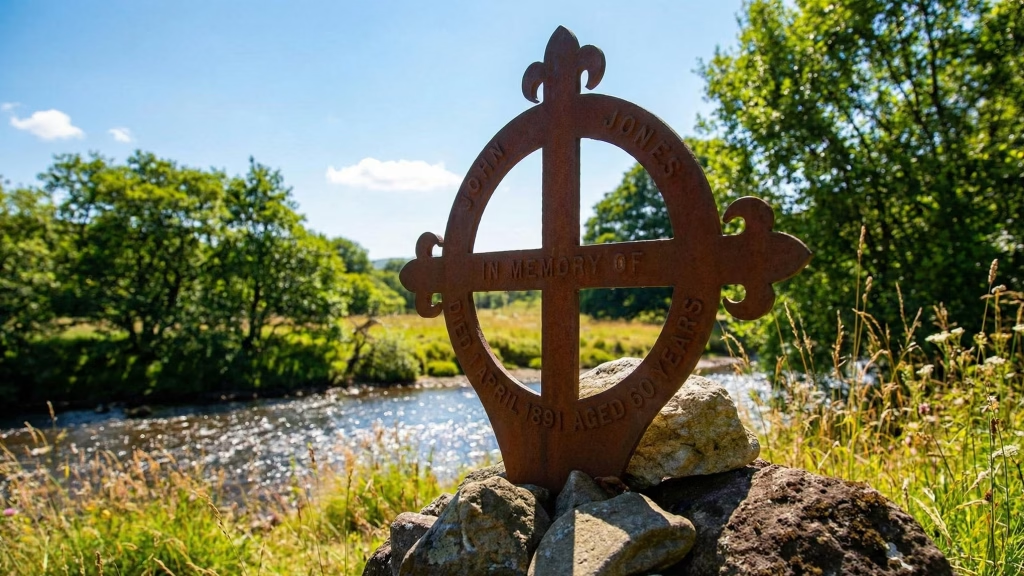
Years later, someone built a cairn at the spot, which stands today in the quiet of the glen. It is a simple pile of stones topped with a cross that locals know as the Pedlar’s Pool. Although it is a lonely place, it reminds us of an important truth: when times are dark, true courage is simply the refusal to leave a neighbor to face the darkness alone.
