



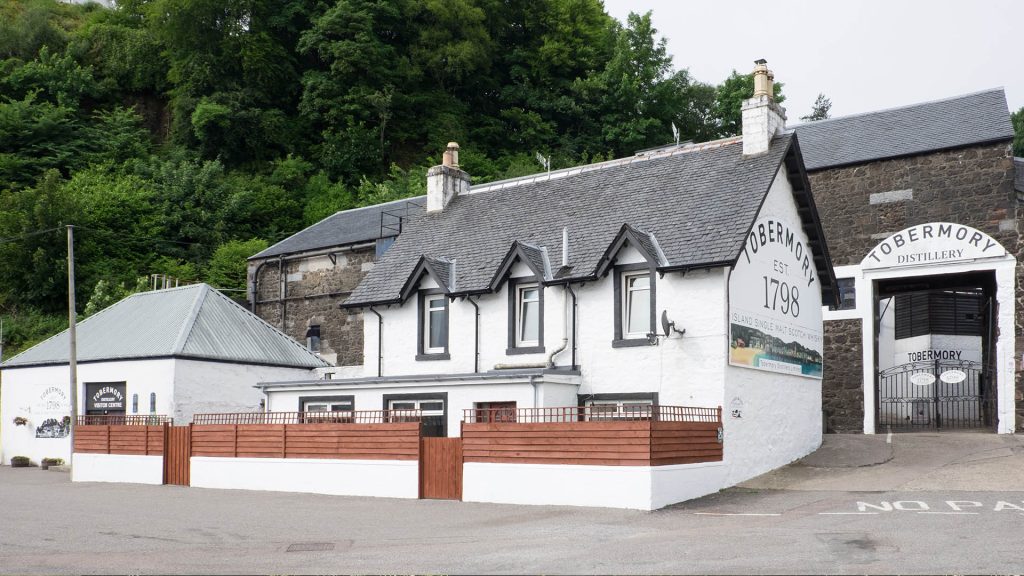
John Sinclair and the founding of Ledaig
The story of Tobermory Distillery began in 1797 when a merchant named John Sinclair arrived in the village. He originally dealt in soda ash produced from burning local kelp. Sinclair saw a future for the harbor and applied for fifty-seven acres of land to the south of the bay. He wanted to build houses and a distillery to support the growing community. At that time the British government had banned distilling to save grain for the war with France. Officials told Sinclair to build a brewery instead but he refused to drop his plans. He eventually founded the site in 1798 under the name Ledaig.

Sinclair also built a local pier known as Sinclair’s Quay to help with transport. Even though the stone buildings went up early the distillery did not receive its official license until 1823. Records from 1822 show that the distillery produced over six thousand gallons of spirit in a single year. Sinclair managed the site for nearly forty years before financial troubles took hold. He ceased production in 1837 and tried to sell the property several times between 1844 and 1851. It seems these early attempts to find a buyer failed as the site remained quiet for many decades.

The Victorian revival and the Hopkins era
Dr. Neil M’Nab Campbell finally acquired the distillery in 1876 and began a major refit. He installed new equipment from engineers at the Townsend Foundry to modernize the process. In 1879 he appointed agents from Glasgow and production started once again. A few years later in 1883 John and Alexander Mackill purchased the site for nine thousand three hundred pounds. However they went bankrupt in 1887 and the distillery went back on the market. In 1888 a firm called John Hopkins and Company took over the business to meet the rising Victorian demand for scotch.

The Distillers Company purchased the site in 1916 during a period of industrial change. However global events soon hurt the market for island spirits. Ten years of Prohibition in the United States caused a massive drop in the demand for whisky. Because of this economic pressure the owners stopped malting at the site in 1930. They only shipped small amounts of stock periodically during this slow period. Their most famous products at this time were known as Old Mull and Old Tobermory. In 1936 the site was sold to John McLean of Edinburgh and all the contents were transferred to the bonded warehouses of the Scottish Malt Distillers’ Company in Campbeltown.
Military history and the return to production
The buildings remained quiet until 1972 when they reopened under the name Ledaig Distillery Tobermory Limited. This new venture saw heavy investment but faced immediate logistical problems. In May 1975 production had to stop for a month because the team ran out of storage space. A delay in building a new bonded warehouse meant they had to lay off fourteen workers temporarily. This crisis led the company into receivership shortly after. The Kirkleavington Property Company then purchased the site in 1978 and reopened it for a few years between 1979 and 1981.
A major change happened in the 1980s that altered the distillery forever. The owners sold off the original bonded warehouses to be converted into residential flats. This meant that maturation could no longer take place on the site at the harbor. The distillery closed again until 1989 when interest in the brand began to grow once more. In 1991 Burn Stewart Distillers purchased the site for six hundred thousand pounds plus extra for the stock. This brought a new level of professionalism and stability to the Isle of Mull’s only distillery.

Modern ownership and the Distell era
In 2002 a company called CL Financial bought Burn Stewart for forty-nine million pounds. This sale included the distilleries at both Tobermory and Deanston. The site remains a famous landmark in the village which is known for its brightly painted houses and its role in children’s television. The distillery sits at the foot of a steep hill right at the head of the bay. In 2012 a very dry summer forced the team to halt production to protect the quality of the whisky. The water levels in the private loch dropped too low to maintain consistency.
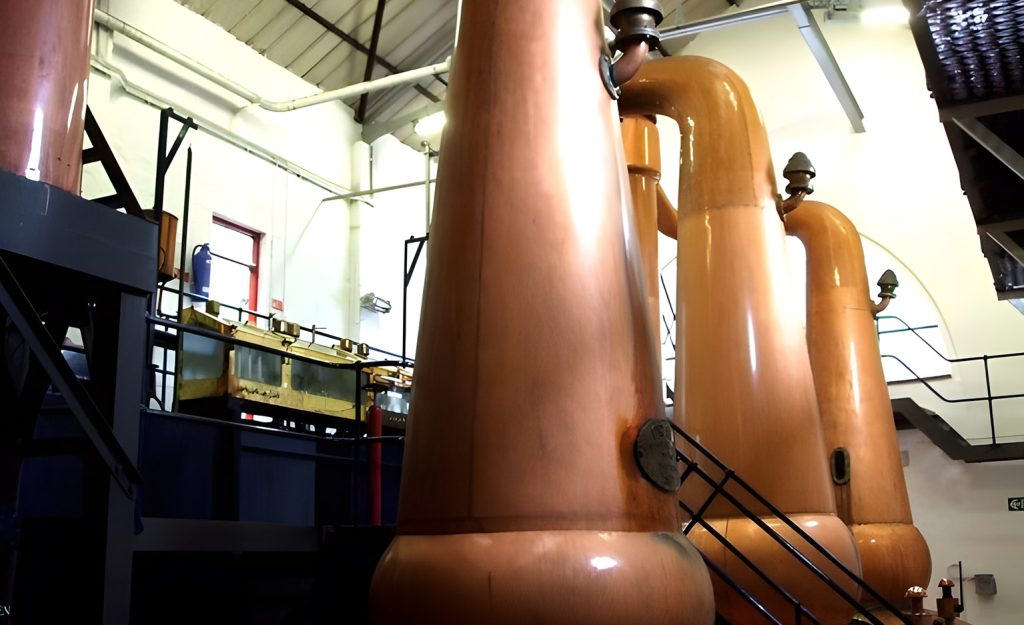
In 2013 Burn Stewart Distillers was bought by Distell Group Limited of South Africa, a subsidiary of Heineken N.V. Today the distillery produces about one million liters of spirit every year. The team uses a traditional copper-domed cast iron mash tun along with four washbacks made of Oregon pine. The distillery has four stills in total: two wash stills and two spirit stills, which together create the unique character of the island malt. Because the harbor warehouses are now private homes all the whisky is sent to the mainland. The spirit matures in oak casks at the Deanston distillery until it is ready for bottling.
Technical details and spirit styles
Tobermory Distillery produces two distinct single malt whiskies that reflect contrasting styles. The unpeated expression, bottled as Tobermory, is made using unpeated malted barley and forms the core of the distillery’s single malt range, with age statements varying by release. Alongside this, the distillery produces Ledaig, a heavily peated single malt named after the distillery’s original historic title. Ledaig is known for its robust smoky character and maritime influence. Both styles are made using water drawn from a private loch in the hills above Tobermory, near the Mishnish lochs.
INSPIRED BY MULL, CRAFTED BY TOBERMORY – Tobermory Distillery brings the spirit of the Isle of Mull to life, crafting whisky inspired by the island’s rugged beauty and vibrant character. Each bottle captures Mull’s essence through artisanal craftsmanship and centuries-old traditions, offering a taste of this unique landscape in every sip.
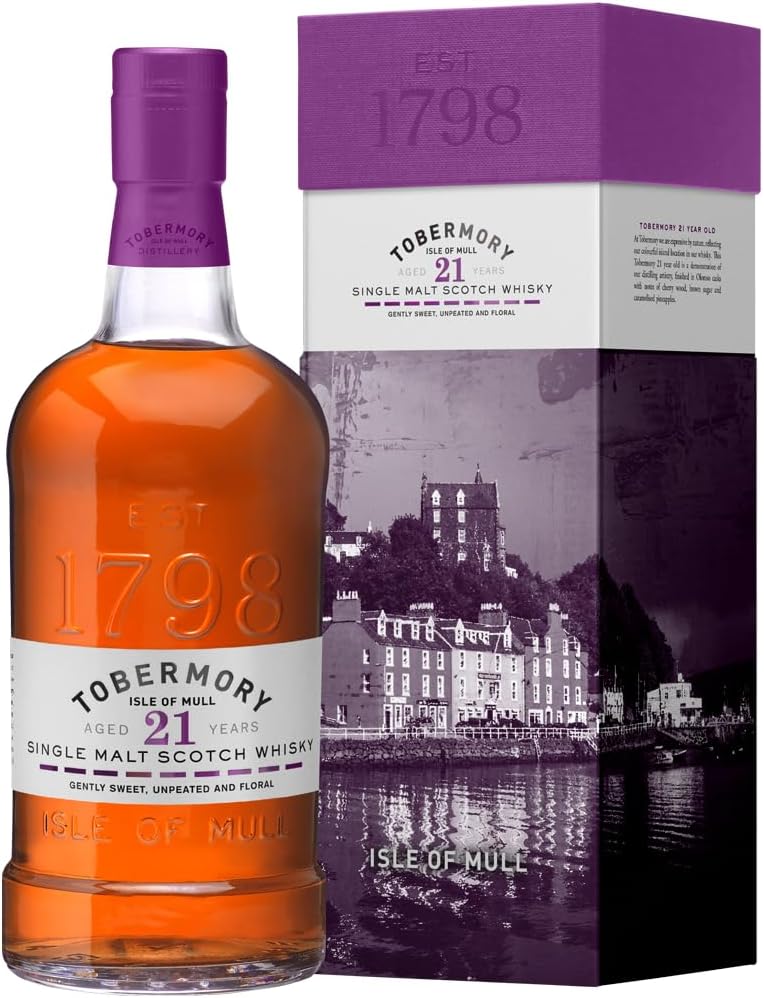

Maturation typically takes place in a combination of ex-bourbon and sherry casks, with the use of different wood types contributing depth and complexity to the finished whisky. Historically, the Tobermory name was used inconsistently across single malts and blends, leading to brand confusion under previous ownership. Since acquiring the distillery, the current owners have clarified the range, clearly distinguishing Tobermory and Ledaig as separate styles while emphasising craftsmanship and heritage. Today, the distillery remains a key presence in Hebridean whisky production and a notable example of resilience within Scotland’s whisky history.
- ABOUT - This expression is made using the same pot stills as the unpeated Tobermory, however has rich medicinal smoky notes. Underlying are notes of fresh fruit and crushed spice.
- INSPIRED BY MULL, CRAFTED BY TOBERMORY – Tobermory Distillery brings the spirit of the Isle of Mull to life, crafting whisky inspired by the island’s rugged beauty and vibrant character. Each bottle captures Mull’s essence through artisanal craftsmanship and centuries-old traditions, offering a taste of this unique landscape in every sip.

