



A major offshore wind farm proposed in the waters around the southern Hebrides is facing growing opposition from island communities, tourism organisations and campaigners, as the project moves into a crucial stage of the Scottish Government’s consent process.
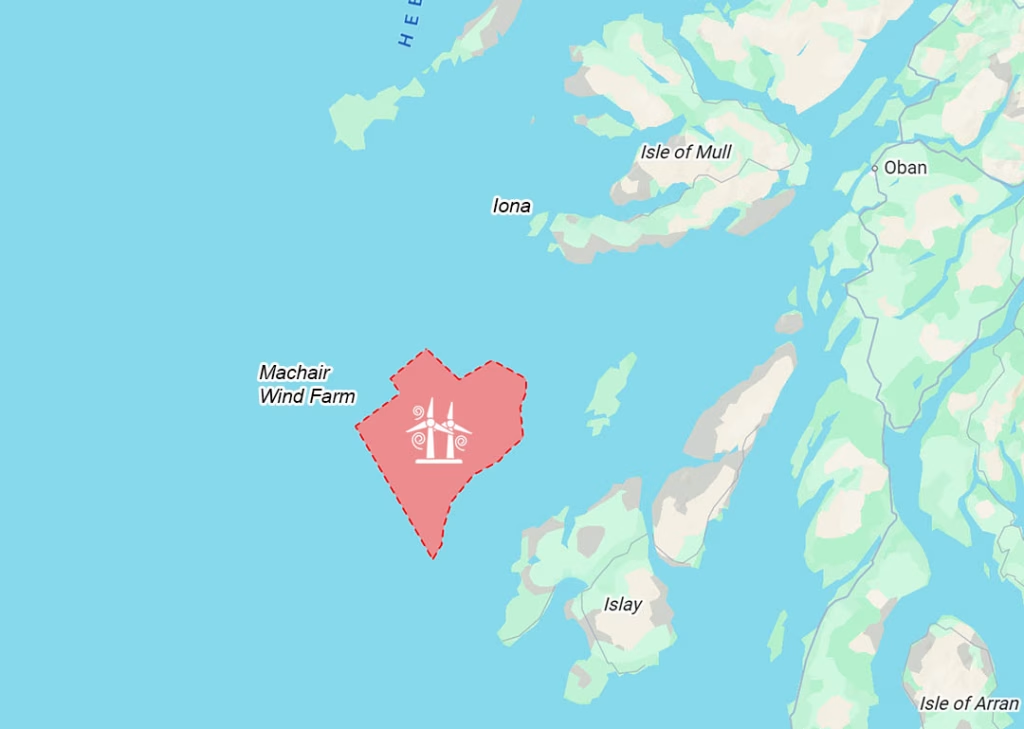
Known as MachairWind, the development is being proposed by ScottishPower Renewables and would occupy approximately 448 square kilometres of sea. The project would contain up to 91 offshore wind turbines, with each turbine reaching approximately 335 metres in height. The development area lies northwest of Islay and west of Colonsay, with the turbines also visible from the surrounding islands, including Iona and Mull.
The scale of the proposed development has become one of the central concerns for people opposing the scheme. The turbines would be taller than the Eiffel Tower, while the development area itself would cover an area equivalent to more than half the land area of Mull. Hebridean Horizon, an islander led campaign opposing MachairWind, says the nearest turbines would be approximately six miles from Colonsay and around 13 miles from Mull and Iona.
The project has now reached a crucial stage
MachairWind is no longer simply a proposal being discussed during early consultation. ScottishPower Renewables formally submitted its consent application to the Scottish Government’s Marine Directorate in June 2026.
The application includes a Section 36 consent application and marine licence applications covering the proposed offshore generating station. The Marine Directorate records the marine licence application for the generating station as reference MD 00012385, while the associated transmission infrastructure application is recorded as MD 00012386. A public notice for the Section 36 application was published on 1 July 2026.
This means the Scottish Government is now considering the formal application and the evidence contained within the extensive environmental assessment. Members of the public and interested organisations have the opportunity to make representations before a decision is eventually reached.
The current deadline for representations is 15 August 2026. Iona Community Council has urged people with an interest in the future of the island to make their views known before that date.
Strong opposition from Iona
The proposal has generated particularly strong opposition on Iona, where the community council has undertaken its own consultation and examined the implications of the development.
Iona Community Council has formally objected to MachairWind, raising concerns about the potential effects on the island’s landscape, cultural heritage, tourism, wildlife and wider environment. The council’s position is significant because Iona occupies an exceptional place in Scotland’s history and is internationally recognised for its religious and cultural heritage.
The concern is not simply about whether individual turbines can be seen from the island. Opponents argue that the surrounding seascape forms part of the setting of Iona and that the introduction of a large scale industrial development into that setting could permanently alter the character of the landscape experienced by residents, visitors and pilgrims.
The campaign against MachairWind has therefore increasingly focused on the relationship between the turbines and the wider cultural landscape rather than treating the development as an isolated offshore engineering project.
Visit Mull and Iona objects
Opposition is not confined to Iona itself. Visit Mull and Iona, the destination marketing organisation representing the islands, formally objected to the MachairWind applications on 4 August 2026.
Its objection points to the legally required Environmental Impact Assessment, which runs to thousands of pages and examines the potential environmental and socioeconomic effects of the development. Visit Mull and Iona has asked that its formal objection be recorded as part of the Scottish Government’s consideration of the Section 36 and marine licence applications.
For an island economy heavily dependent on scenery, wildlife, heritage and tourism, the potential effect on the character of the surrounding landscape is an important issue. The organisation has argued that the consequences of such a large development need to be properly assessed before permission is granted.
Environmental and wildlife concerns
Environmental impacts form another major part of the debate. The formal application contains extensive assessments covering marine mammals, birds, fish, seabirds and other aspects of the marine environment.
Campaigners have questioned whether the available evidence fully demonstrates that the development can proceed without unacceptable effects on sensitive species and habitats. The environmental assessment is now being examined by the relevant statutory bodies as part of the consent process.
This is an important distinction. The existence of concerns or requests for further information does not mean that environmental damage has been established as a fact. The purpose of the assessment and consultation process is to establish the likely effects and determine whether those effects can be adequately avoided, reduced or mitigated.
What ScottishPower Renewables says
ScottishPower Renewables maintains that MachairWind could make a substantial contribution to Scotland’s renewable energy ambitions. The company describes the project as having a generating capacity of approximately 2 gigawatts and says it could generate enough electricity to supply more than two million Scottish homes.
The company has also emphasised potential economic opportunities for communities and businesses across the west coast islands and surrounding areas. It has previously established a £10,000 community donations fund covering communities including Iona and the Ross of Mull.
The developer therefore presents MachairWind as an important part of Scotland’s transition towards renewable electricity, while opponents argue that the location and scale of the project make it inappropriate for this particular part of the Hebrides.
The petition against MachairWind
An islander led campaign called Hebridean Horizon has been established to oppose the development and raise awareness of the potential effects on the islands, their communities, wildlife and surrounding seas.
The campaign has launched a public petition calling for opposition to MachairWind. Anyone who wants to support the petition can sign it here:
Sign the petition against MachairWind
The petition states that the campaign is seeking protection for the Hebridean landscape, seas, wildlife and communities from what it considers to be inappropriate industrialisation.
People who wish to make their views part of the formal Scottish Government consultation should also submit an official objection rather than relying solely on signing the petition. A dedicated Object Now page provides a straightforward way to submit an objection to the MachairWind proposal.
The deadline for representations is 15 August 2026. Information about making an objection and the relevant application documents are available through the Marine Directorate and the Hebridean Horizon campaign.
What happens next?
MachairWind has not been approved and construction cannot begin simply because the application has been submitted. The Scottish Government must now consider the application, environmental evidence and representations from members of the public, communities, organisations and statutory consultees.
ScottishPower Renewables has described the submission as an important milestone in the project, while opponents see the current consultation as a crucial opportunity to challenge the scale and location of the proposed development.
For Mull and Iona, the debate is therefore entering a particularly important period. The decision will ultimately determine whether one of Scotland’s largest proposed offshore wind developments can be built within sight of these historic Hebridean islands.
Whatever view people take of offshore wind energy itself, the immediate opportunity to have a documented say in the MachairWind proposal is now open. The formal consultation deadline is 15 August 2026, while the campaign petition remains available for those who wish to register their opposition.
