



The Bloodline and the Battle Axe: Founding the Maclean Dynasty
The story of the Macleans is a powerful Highland tale defined by iron resolve, strategic alliances, and unbreakable loyalty. It begins not with a castle, but with a warrior: Gillean of the Battle Axe (Gilleathain na Tuaighe). Emerging in the 13th century, Gillean’s epithet speaks directly to his prowess. The battle axe is therefore the historical emblem tied to Gillean, while the Castle Tower (representing Duart) became the enduring symbol featured on the clan’s crest badge.

According to later clan tradition, his lineage traces back through the ancient Irish and Scottish royal lines, lending a noble and martial air to the clan’s origins. Gillean was a formidable figure whose exploits helped secure a place for his family amidst the tumultuous conflicts of the time, especially the wars between the Scots and the Norse for control of the western islands.

The legendary origin of the Maclean crest is tied directly to Gillean’s constant companion, his battle axe. While engaged in a stag-hunt on the mountain of Bein ‘tsheata, a heavy mist suddenly obscured the path, causing Gillean to lose his way. After wandering for three days, exhausted, he fixed the handle of his battle axe into the earth within a cranberry bush and collapsed, insensibly, with his arms wrapped around the handle. On the fourth day, his friends discovered the head of the battle axe visible above the bush, leading them to their chief and accounting for the eventual inclusion of the axe, laurel, and cypress motif, symbols of endurance and military honour, in the clan’s heraldry.
The Strategic Marriage and the Acquisition of Duart
Lachlan Lubanach Maclean, Gillean’s great-grandson, truly cemented the family’s future. The Macleans first occupied lands on Iona and Morvern. However, they began their rise through a masterstroke of political pragmatism: a marriage of alliance.
Lachlan Lubanach married Mary Macdonald, the daughter of John, the first Lord of the Isles. This powerful alliance became the absolute foundation of Maclean power. The Lord of the Isles ruled a vast, semi-independent maritime kingdom and desperately needed fierce, loyal lieutenants to control his territories. In exchange for their fealty and military service, the Macleans received extensive lands, including the majority of the Isle of Mull and, most critically, the fortress that would become their heart: Duart Castle.
By the late 14th century, the Macleans had firmly established Duart as their stronghold. The castle sits strategically on a headland, guarding the confluence of the Sound of Mull and the Firth of Lorne. It functioned not merely as a defensive structure, but as the seat of a maritime power. The Macleans commanded a powerful fleet of galleys (birlinns), earning the title of Lieutenants of the Lords of the Isles. They enforced control over the sea lanes, making Duart their command centre and supply base. The clan’s rise from a single warrior to a regional power within a century demonstrates their exceptional military skill and strategic marriages.
The Golden Age and the Seeds of Conflict
The 15th century marked the zenith of Maclean influence. Although technically vassals, they governed their domain like sovereign princes. The clan branched into distinct lines, notably the Macleans of Duart (the Chiefs) and the powerful cadet branches of Coll and Lochbuie.
However, the stable political order the Macleans relied upon shattered with the collapse of the Lordship of the Isles in 1493. They now reported directly to the distant Scottish Crown. Consequently, the Macleans were forced into a precarious position, navigating new rivalries, primarily with the emerging and aggressively expansionist Clan Campbell.
Lachlan Cattanach and the Lady’s Rock Feud
The story of Lachlan Cattanach Maclean, the 11th Chief, illustrates this dangerous period vividly. He attempted to cement an alliance with the mighty Campbells by marrying Catherine Campbell, sister to the Earl of Argyll. Tragically, the marriage went wrong, leading to legendary violence.
Lachlan Cattanach committed a shocking act of cruelty. Frustrated over the lack of a male heir and political dissatisfaction, he marooned his wife on the tidal rock known as Lady’s Rock (Creag an Uisge) near Duart. He intended for the rising tide to wash her away, freeing him of the marriage without drawing official royal censure.

The attempt failed. Fishermen rescued Catherine, and she returned safely to her brother, the Earl of Argyll. Lachlan proceeded to Inveraray to offer false condolences, only to confront his very much alive wife. Although he escaped that immediate encounter, the insult was too great. Years later, in 1538, Sir John Campbell of Calder, Catherine’s vengeful brother, murdered Lachlan in Edinburgh. This event cemented a deep, bloody feud between the Macleans and the Campbells that defined the next two centuries of their history. Furthermore, it marked the Macleans as enemies of the rising power in the Highlands.
The Immortal Loyalty at the Battle of Inverkeithing
The 17th century brought cataclysm to Scotland. The Macleans’ deep-seated loyalty to the Stuart monarchy meant they frequently found themselves on the losing side of major conflicts.
The clan’s military prowess became legendary. Under the banner of the Royalist cause, the Macleans fought fiercely alongside the Marquis of Montrose. The 17th Chief, Sir Lachlan Maclean, was a key figure who led his men in a series of swift and devastating victories against the Covenanters.
However, this loyalty exacted an immense cost. The most famous example occurred during the Battle of Inverkeithing in 1651. Sir Hector Maclean, the 18th Chief, led the Macleans. They engaged in a desperate rear-guard action to cover the retreat of the Royalist army.

Surrounded by overwhelming Parliamentary forces, Sir Hector’s life was in immediate danger. What followed became the clan’s immortal battle-cry. As the enemy closed in, clansmen took turns stepping forward to shield their chief from musket fire. With each man who fell, another stepped up, shouting the Gaelic phrase: Fear eile airson Eachainn! which translates to “Another for Hector!” Records state that seven brothers from the Maclean family died performing this ultimate act of sacrifice before Sir Hector himself fell. This heroic devotion defines Maclean military culture and remains the most powerful symbol of their honour.
Duart Defies Cromwell
The Macleans were also cunning and pragmatic fighters. In the aftermath of Montrose’s defeat, Sir Allan Maclean, the 19th Chief, oversaw Duart Castle, which came under threat from the forces of Oliver Cromwell. In 1653, General George Monck commanded a fleet attempting a naval action against the stronghold, but the assault was unsuccessful.

A violent storm wrecked several of Monck’s ships on the rocks below Duart, preventing a landing. The castle remained unconquered by direct assault, and the Commonwealth forces eventually withdrew. Duart thus resisted Cromwellian forces, earning a reputation as one of the few Highland strongholds not taken by force during the period.
Financial Ruin and Loss to the Campbells
The political tide, unlike the castle walls, could not be held back. Following the Glorious Revolution of 1688, the Macleans remained devoted Jacobites, supporting the exiled King James VII. This positioned them in direct opposition to the new Protestant regime and, crucially, in opposition to the now immensely powerful and government-backed Campbell Dukes of Argyll.
The Campbells sought ownership, not battle. They leveraged their political influence and the crushing financial debts the Macleans had accrued over decades of warfare. The Macleans constantly raised regiments and paid for supplies, leading to their financial ruin.
The final blow came in 1691. The Clan Campbell used legal processes backed by military threat to seize Duart Castle and the vast majority of the Maclean lands on Mull and Morvern to settle outstanding debts. The staggering debt was a direct consequence of the clan’s unwavering loyalty to the defeated Stuart cause.
The Long Silence and the Emigration
Sir John Maclean, the 4th Baronet, abandoned his home. He left the keys not to the Campbells, but in the care of a trusted cousin, who then reluctantly turned them over. Duart was subsequently garrisoned by Crown troops loyal to the Earl of Argyll, a final and bitter humiliation for the clan.
The castle soon fell into disuse. By the mid-18th century, with the final defeat of the Jacobite cause at Culloden in 1746, the Crown completely abandoned Duart. They removed its roof, its timbers rotted, and its beautiful stonework began to crumble under the relentless Hebridean weather. The heart of the Maclean clan became a shell, a romantic but tragic ruin for over 150 years.

The Chiefs and their people dispersed. Many joined the great emigration, leaving for Canada, America, Australia, and New Zealand. This emigration was part of the wider Highland Clearances, though the Macleans’ loss of their estate preceded it. Yet, even across oceans, the memory of Duart and the identity of the clan persisted.
Sir Fitzroy’s Vow and the 1911 Repurchase
The story of the Macleans is unique because it did not end in ruin; instead, it culminated in one of the most remarkable acts of ancestral reclamation in Scottish history.
For generations, Duart Castle remained in ruins after its loss in 1691, with its roof gone and walls deteriorating. Recovering the ancestral seat seemed an impossible dream, until Colonel Sir Fitzroy Donald Maclean, the 26th Chief, took up the challenge. Born in 1835, he carried forward the determination to see the Maclean banner fly over Duart once more.
In 1911, at the age of 76, Sir Fitzroy successfully repurchased the castle from the Campbell estate, bringing it back into Maclean hands after more than two centuries. The fortress was largely ruinous, with crumbling walls and missing floors, requiring extensive rebuilding. His restoration work focused on making the castle structurally sound while preserving its historic character, laying the foundation for Duart to become the living seat of the Maclean chiefs once again.

The Great Restoration and the Global Homecoming
The ensuing restoration was less a mere rebuilding and more a passionate rescue. Sir Fitzroy poured his own fortune and the contributions of Macleans around the world into the project. The work was painstaking, focusing on preserving the original mediaeval character while ensuring the castle was structurally sound and habitable. Master masons and craftsmen were brought in to re-roof the keep, replace entire floor structures, and reinforce the crumbling seaward walls that had resisted the Atlantic for centuries.
On August 24, 1912, the restoration was complete enough to celebrate. The Clan Gathering of 1912 was an emotional global homecoming. Hundreds of Macleans, descendants of those who had fought and emigrated centuries earlier, travelled back to Mull to witness their Chief raise the Maclean banner over the restored keep. It was a powerful, tangible affirmation that the clan had endured, proving that their identity was defined not by the land they lost, but by the loyalty they retained.
Duart Castle Today: A Living Legacy
Today, Duart Castle is not a museum piece or a simple tourist attraction. It is the living, inhabited seat of the Chief of Clan Maclean. The family owns and manages it, and it remains the residence of the current Chief, Sir Lachlan Maclean, who represents the 28th Chief of the clan, continuing the unbroken line of succession and stewardship.
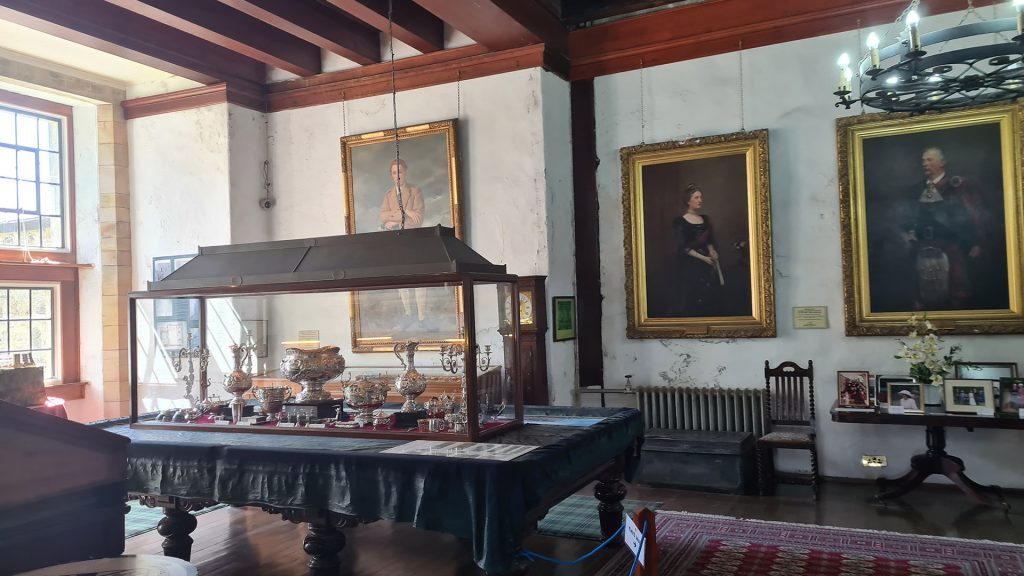
The castle houses an extensive collection of Maclean artefacts, uniforms, and historical exhibits, detailing the dramatic military and political saga. Visitors are welcomed as if they are returning to the clan’s ancestral home, reinforcing the strong sense of kinship that Sir Fitzroy worked so hard to restore.
The experience of visiting Duart means walking through history. You can stand in the dungeons where prisoners of clan feuds were held. Look out from the ramparts that defied Cromwell. Reflect on the turbulent waters surrounding Lady’s Rock. The Sea Room offers commanding views, while the Banqueting Hall speaks to the hospitality and authority of the ancient Chiefs.

The Macleans of Duart represent the ultimate triumph of enduring identity. They lost their lands, their fortunes, and their castle, but they never lost their name or their spirit. They clawed their way back through centuries of adversity to reclaim their destiny. The restored Duart Castle is more than a building; it is a profound symbol of the resilience of the Highland clans and the enduring power of a shared heritage.
