



Most people arrive on the Isle of Mull in a hurry. You drive off the big CalMac ferry in Craignure and your instinct is to hit the accelerator. You want to get ahead of the caravan in front of you, or perhaps you are rushing to make a dinner reservation in Tobermory. However, in that mad dash to start your holiday, it is very easy to miss the most important piece of history in the village.
Notably, this history is not the castle on the headland, nor is it the ferry terminal itself. Instead, it is a pair of stone pillars standing quietly outside the Craignure Police Station.

If you have ever walked past the police station and wondered why there are two weathered stone gateposts standing there, you are looking at the original Pennygates. These stones serve as the physical remnants of a time when entering Mull was a transaction rather than just a journey. Furthermore, they are the reason the nearby Pennygate Lodge has its name, and they tell a story of the island that most guidebooks completely overlook.
The Stones at the Station
Curiously, the police station seems like a strange place to find a piece of 19th century infrastructure. The building is a modern necessity, sitting near the ferry terminal to keep an eye on the comings and goings of the port. Nevertheless, those stones standing guard outside are much older than the structure behind them.
Originally, these pillars marked the gateway to the pier area. They acted as the checkpoint. In the 1800s, you could not just wander onto the island or stroll down to the boats without dealing with the authority these stones represented.
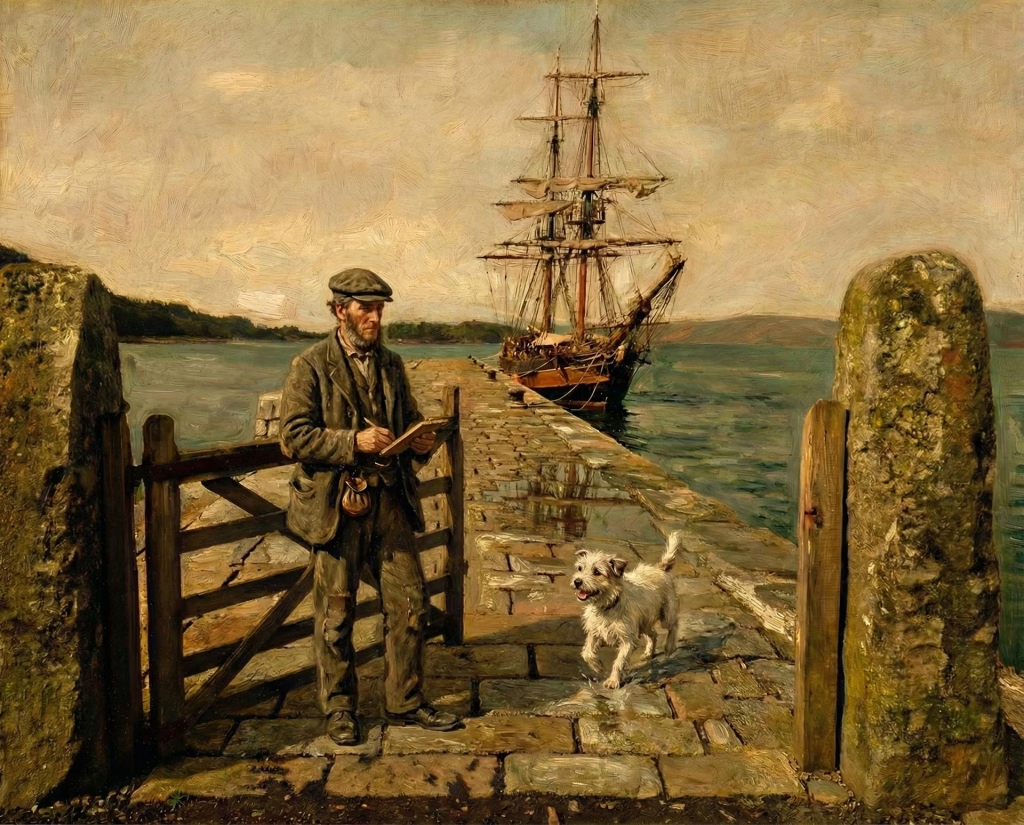
Local history suggests that workers moved these pillars to their current spot near the police station for preservation. In fact, it is quite a fitting location when you think about it. They spent their early life acting as a form of border control and enforcing the law of the toll. Now they sit outside the office of the local police, where they still keep watch over the village, even if they no longer demand a penny from you to pass.
What the Plaque Says
You do not have to guess at the history when you visit because a small information plaque right next to the stones explains their origin. Specifically, it confirms that the stones were not just decorative but functioned as essential tools of the estate.
The inscription records that the famous Stevenson family, the same dynasty of engineers responsible for Scotland’s greatest lighthouses, built the old pier around 1853. It goes on to explain that the estate raised these stones some time later as part of a toll gate.

Workers originally placed them on either side of the road from the pier, and the gatekeeper extracted a penny from anyone wishing to pass through and on to the island. Reading that plaque brings the reality of the situation home. Consequently, you understand it was a strict system. If you wanted to cross from the Stevenson pier to the rest of Mull, you paid your penny.
The Lodge and the Law
To understand the stones, you have to look at the house they once served. Just a short distance away stands Pennygate Lodge. Although today it is a beautiful guesthouse where you can get an incredible meal, builders constructed it in 1831 with a very different purpose in mind.
Back then, it functioned as the portal to the island. The name Pennygate is not a quaint invention by a marketing team. Rather, it is a literal description of what happened there. This was the place where the toll keeper administered the fees.
We take free roads for granted now. We assume that once we pay for the ferry ticket, we can use the rest of the infrastructure freely. However, in the early 19th century, maintaining a pier and a track suitable for cattle and carts was expensive work. Therefore, the local lairds and landowners needed to recoup that cost.
Pennygate Lodge served as the administration center for this. As a Georgian building, it projected power. It stood solid, symmetrical, and serious. Effectively, it told the cattle drovers and the merchants that this was a place of business. When you stood between the stones that are now at the police station, you were standing at the border of the estate. You paid your penny, or you did not go any further.
The Value of a Penny
It is funny to call it Pennygate today because a penny sounds like nothing. You would probably walk past a penny on the pavement without picking it up. Conversely, in the 1830s, a penny represented a serious amount of money for a regular person.
For a drover bringing cattle from the Ross of Mull to sell on the mainland, every penny counted. Meanwhile, for a local crofter, that toll became a genuine tax on movement. The toll keeper who lived in the lodge held a position of real authority. He acted as the gatekeeper to the economy of the mainland. If you could not pay the toll at the stones, you could not get your goods to the market in Oban.
The stones at the police station stand as a monument to that commerce. They have seen thousands of people pass through. Additionally, they witnessed the height of the kelp industry when locals harvested seaweed for alkali. They saw the sadness of the Highland Clearances as people left the island forever. Finally, they watched the arrival of the first steamships that started to bring Victorian tourists to see the wonders of Staffa and Iona.
A Hidden Landmark
The amazing thing about the stones is how they hide in plain sight. Craignure is a transit hub. It is full of cars queuing for the ferry, buses turning around, and foot passengers looking for the toilets. Undoubtedly, it is noisy and chaotic.
Amidst all that modern noise, the Pennygates stand silent. Made of local stone, they have withstood nearly two hundred years of Atlantic rain and salt spray. They are rough and functional. The masons did not build them to be pretty. Instead, they built them to be sturdy.
By keeping them outside the police station, the village has preserved a link to its past that is arguably more authentic than a museum exhibit. You can walk right up to them. Furthermore, you can touch the rough surface of the stone and imagine the metal gate that once swung between them. You can picture the toll collector stepping out of the lodge on a wet November night in 1860 to demand payment from a traveler soaked to the bone.
Pennygate Lodge Today
The story has a happy ending, however. The toll is long gone, and the stones have retired to the police station. Moreover, the building that started it all, Pennygate Lodge, has transformed into one of the best spots on the island.

It is no longer a place that demands money just for you to walk past. Now it is a place that welcomes people in. The owners have restored the lodge beautifully. It retains that Georgian grandeur that made it so imposing in the 1830s, but the atmosphere has softened completely.
Currently, the owners have turned it into a sanctuary for food lovers. Instead of counting coins, they are counting food miles, which are usually very low because they source so much from the island itself. They serve local venison, seafood landed at the pier nearby, and produce from local gardens.
There is a nice symmetry to it. The building once acted as the bottleneck of the island, the place that controlled access. Now it serves as a destination. People travel to Craignure specifically to go there, rather than just passing through it.
Why You Should Look for the Stones
Next time you are waiting for the ferry in Craignure, do not just sit in your car scrolling on your phone. Get out and stretch your legs. Walk past the pub and head towards the police station.
Look for the stones and read the plaque regarding the Stevenson pier. Although it is a small detail, it makes the village feel different. It grounds the place. Effectively, it reminds you that before the CalMac ferries and the campervans, this was a working coastline where everything had a price.
The Pennygate stones remain there to remind us of that reality. They stand quietly on duty outside the police station, guarding a toll that nobody has to pay anymore.
