



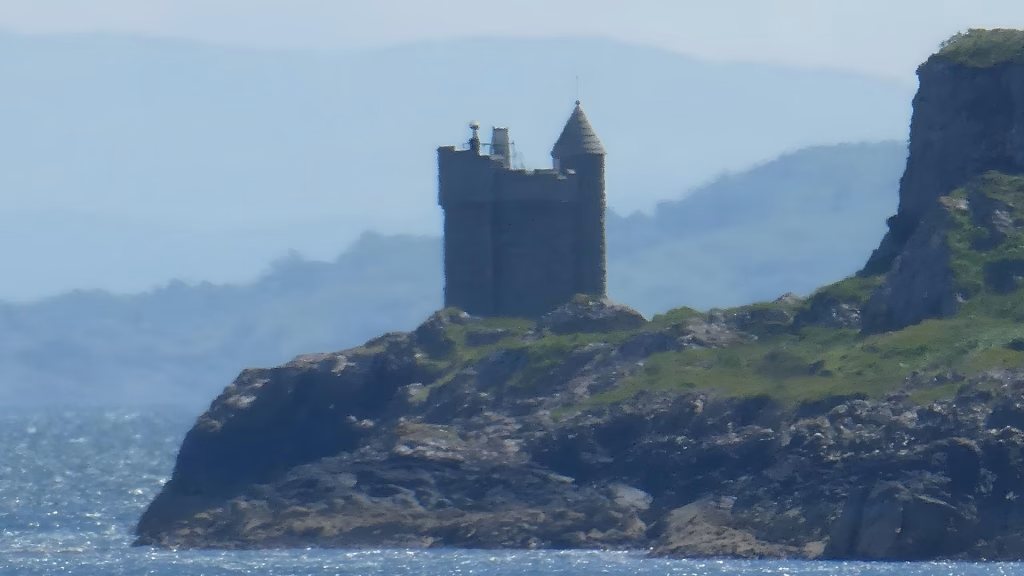
Black’s Tower also known as Duart Point Lighthouse stands on the rocky headland at the south eastern edge of the Sound of Mull on the Isle of Mull in Argyll. The site looks across the water toward the mainland and guards a channel that for centuries carried fishing craft, trading vessels and later steamers through the Inner Hebrides. Just to the north rises Duart Castle, long the seat of Clan Maclean, whose presence on this coast shaped the political and maritime history of the district from the later Middle Ages onward.
The Sound of Mull as a Historic Sea Route
The Sound of Mull formed a vital sea route between the Firth of Lorn and the Minch. Before the age of modern navigation, ships relied on local knowledge, coastal landmarks and favourable tides to pass safely between reefs and skerries. Lady’s Rock, a notorious reef lying off Duart Point, posed particular danger. Tradition associates it with an episode in the sixteenth century when Lachlan Cattanach Maclean abandoned his wife there at low tide, though she survived. Whatever the truth of that story, the reef remained a real hazard to mariners.
During the eighteenth and nineteenth centuries maritime traffic increased steadily. The growth of coastal trade, fishing, and passenger travel by steamer made the Sound of Mull busier than ever before. The Northern Lighthouse Board, established in 1786 to oversee aids to navigation in Scotland, gradually expanded its network of lights across the west coast. Yet for much of the nineteenth century Duart Point itself had no lighthouse, even though vessels rounding the headland had to avoid Lady’s Rock and other submerged dangers.
William Black and Mull
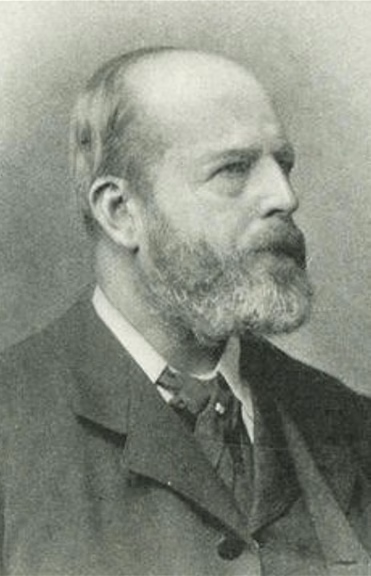
The story of the lighthouse cannot be separated from the life of William Black. Born in Glasgow in 1841, Black became a popular novelist whose works often drew inspiration from the Scottish landscape. He developed a deep affection for the west coast and spent time on Mull, where the scenery, light and sea passages influenced his writing. His novel A Princess of Thule and other works helped shape Victorian perceptions of the Hebrides as romantic and dramatic places.
Black came to know Duart Point intimately. He valued its wide views and the sense of elemental force where sea and rock meet. Friends later recalled how much he loved that particular stretch of coast. When he died in 1898, admirers in Britain and abroad sought a fitting memorial. Rather than erect a statue in a city, they chose to commemorate him in the landscape he cherished.

The Idea of a Memorial Lighthouse
The idea emerged to build a lighthouse at Duart Point both as a tribute to Black and as a practical benefit to mariners. At the turn of the twentieth century, steamer traffic through the Sound of Mull had become regular, linking Oban, Tobermory and other west coast ports. Shipwrecks in the vicinity underscored the need for improved navigational aids. Supporters of the memorial believed that a lighthouse would unite sentiment with service.
A public subscription raised funds from readers and friends in Britain and the United States. The project proceeded in cooperation with the Northern Lighthouse Board, whose engineer David Alan Stevenson oversaw many Scottish lighthouse works of the period. For the design, the committee turned to Sir William Leiper, an Edinburgh architect known for his distinctive and often romantic style.
Construction on the Headland
Construction began around 1900 on the exposed headland. Builders had to contend with weather, sea spray and the difficulty of transporting materials to the site. The finished structure rose in 1901. Above the entrance they placed a plaque recording that the lighthouse stood as a memorial to William Black on a spot he knew and loved. The light first shone in May 1901.
Contemporary reports noted that the works required careful coordination between architect, engineer and contractor to ensure that the memorial design met official navigational standards. The lantern apparatus and gas installation underwent inspection before activation, and final adjustments to the flash sequence took place shortly before commissioning. Once approved, the light entered service under the authority of the Northern Lighthouse Board, formally adding Duart Point to Scotland’s established system of coastal aids to navigation.
Architectural Character and Design
Duart Point Lighthouse differs markedly from the austere towers that characterize many Scottish lights. Leiper gave it a castellated Gothic appearance that echoes the nearby medieval stronghold of Duart Castle. The tower, built of granite, incorporates battlement details and a form that suggests a small coastal fortress rather than a purely functional beacon.
This choice of style reflected the commemorative purpose of the building. While it fulfilled the technical requirements set by the Northern Lighthouse Board, it also embodied the romantic vision associated with Black’s writing. The structure rises to a modest height, sufficient to cast its beam across the approaches to the Sound. Its position on elevated ground above the shore increases the range of the light.
Early Lighting Technology
Originally the lighthouse operated using a compressed gas system, a technology common at the time for minor lights. The flashing characteristic distinguished it from neighbouring beacons and warned vessels of Lady’s Rock and the surrounding reefs. The combination of aesthetic flourish and engineering precision makes Duart Point an unusual example within the wider family of Scottish lighthouses.
Twentieth Century Service
Throughout the twentieth century Duart Point Lighthouse served the growing maritime network of the west coast. Steamers of the David MacBrayne fleet, fishing boats, naval vessels during the First and Second World Wars, and later motor ferries all passed within sight of its tower. The Sound of Mull remained a busy channel linking the Clyde, Oban and the northern Hebrides.
Modernisation and Automation
Technological change gradually altered the way the lighthouse functioned. Improvements in lighting apparatus and power sources led to modernization. The original gas system eventually gave way to more efficient equipment. In time the light became automated, removing the need for a resident keeper. Solar panels and modern optics now ensure that the beacon continues to operate reliably in harsh weather.
Despite these updates, the external appearance of the tower has remained largely unchanged. It retains its distinctive silhouette against the sky and its visual dialogue with Duart Castle to the north. The setting continues to evoke the blend of natural drama and human craftsmanship that first inspired its creation.
Heritage and Cultural Significance
Today Duart Point Lighthouse forms part of the historic and scenic landscape of Mull. Visitors walking from Duart Castle often follow the coastal path to the headland, where they encounter the memorial plaque and the wide sweep of the Sound. The lighthouse stands not only as an aid to navigation but also as a marker of literary memory.
Its status as the Sir William Black Memorial Lighthouse preserves the connection between place and author. In contrast to urban monuments, this memorial integrates commemoration with public utility. It reflects a period when communities sought to honour cultural figures through works that benefited society at large.
Within the broader history of Scottish lighthouses, Duart Point occupies a distinctive niche. The Northern Lighthouse Board constructed many towers during the nineteenth century, often in remote and hazardous locations. Most followed a functional architectural language shaped by the Stevenson engineering dynasty. At Duart Point, collaboration between engineer and architect produced something more expressive while still meeting navigational needs.
More than a century after its first illumination, the lighthouse continues to mark the entrance to the Sound of Mull. Ships equipped with modern electronic navigation still rely on visual aids as a safeguard in poor visibility or equipment failure. The steady flash from Duart Point links present day mariners with those who sailed these waters in sail powered craft centuries ago.
In this way the lighthouse unites layers of history. It recalls the medieval power of Clan Maclean at Duart Castle, the growth of maritime trade in the eighteenth and nineteenth centuries, the literary imagination of William Black, and the technical progress of Scottish lighthouse engineering. Set against sea and sky, it remains a working structure whose story enriches the wider heritage of Mull and the Inner Hebrides.

Character: Flashing white and red every 18 seconds
Elevation: 14 metres
Range: 5 nautical miles
