



The Isle of Mull hosts a landscape defined by contrast: rare, lichen-drenched “Celtic Rainforests” clinging to the coast, and vast commercial plantations dominating the glens. Whether you look for the twisted silhouette of an ancient oak or the uniform darkness of a spruce thicket, the woodlands here provide the stage for some of Scotland’s most dramatic wildlife encounters.
The primary custodian for this rugged terrain is Forestry and Land Scotland (FLS). They manage thousands of hectares, balancing timber production with wildlife conservation and maintaining the essential network of tracks and hides where White-tailed Eagles thrive alongside heavy machinery.
However, the story isn’t just about government timber. A growing movement of community trusts and private estates now protects a staggering variety of trees, from ornamental gardens to wild cliff-side woods. This guide details every woodland and forest across the island, covering their size, character, and location.
The North and Central Commercial Plantations
Lettermore Forest
Lettermore Forest represents the largest single continuous block of forestry on Mull, occupying approximately 1,941 hectares. Commercial Sitka Spruce and Lodgepole Pine dominate this woodland, which forestry teams manage primarily for timber production. It sits centrally near Salen, providing a dense, continuous cover that raptors use as a critical habitat. While it shares a name with the mainland wood famous for the Appin Murder, this Lettermore remains a distinct Mull location and a key economic asset for the island’s timber industry.
Crannich Forest
Crannich Forest spans roughly 800 hectares within the larger Central Mull complex. Located near Loch Frisa, the forest consists of deep commercial conifer planting where Spruce and Pine grow thickly. Density and scale characterize the forest, which managers oversee for high-yield timber. Recent management plans focus on restructuring the area to remove Larch trees as a precaution against disease. Its edges border open moorland, making the perimeter an excellent location for spotting birds of prey hunting over the heather.
Aintuim Forest
Aintuim covers an area of approximately 450 hectares. Situated towards the northwest near Dervaig, the forest serves as a vital water catchment area for the River Bellart. Like its neighbors, mixed commercial conifers largely make up the woodland. While it sees less recreational foot traffic than the more tourist-focused sites, it remains a significant working block. The dense canopy here helps regulate water flow into the river system.
Salen Forest
Distinct from the village of Salen itself, this forest covers exactly 656 hectares on the slopes above the settlement. Foresters primarily planted commercial conifers here on what were historically ancient woodland sites. Currently, management strategies focus on gradual restoration, aiming to slowly replace the non-native timber with broadleaf species. This shift will improve biodiversity and stabilize the slopes overlooking the community.
Ardmore Forest
Ardmore is a substantial plantation covering 600 hectares as part of the wider North Mull management area. Facing out toward the islands of Coll and Tiree, the forest comprises Sitka Spruce and Lodgepole Pine. Beyond its timber, the site holds significant cultural history because it contains the ruined village of Penalbanach. It also serves a critical modern function as a drinking water catchment source for the Tobermory Distillery.
Quinish Forest
Quinish Forest is a large plantation of approximately 400 hectares. Located near Dervaig in the northwest, commercial conifers flank the path to the Mingary Burn catchment. It is a substantial working forest that offers long-distance routes leading eventually to Quinish Point. The landscape transitions from dense spruce blocks to open coastal scrub as you approach the sea.
Loch Frisa Forest
The forestry flanking Loch Frisa covers a massive stretch of land, totaling around 1,500 hectares when combined with the adjacent Glen Aros block. Although the forest contains primarily commercial Sitka Spruce, Forestry and Land Scotland manages it heavily for wildlife tourism. Notably, this area is the most famous territory for Mull’s White-tailed Eagles. The trees here provide the necessary height and cover for eagle nests.
Recreational and Coastal Forests
Aros Park
Aros Park covers a compact but diverse 60 hectares. Located just south of Tobermory, it features a mix of exotic specimen trees, mature firs, and native ferns, which distinguishes it from the commercial blocks. The original owners designed the landscape rather than planting it for function, so it incorporates waterfalls and decorative planting. It serves as the primary recreational forest for the island’s capital.
Fishnish Forest
Fishnish Forest covers approximately 250 hectares along the eastern coast. It is a mixed woodland where commercial timber grows alongside amenity planting. Uniquely, the forest is relatively flat compared to the inland blocks, and visitors know it well for its wildlife hide. The trees here run right down to the shoreline, providing cover for otters moving between the sea and the forest burns.
Garmony
The Garmony woodland strip covers roughly 80 hectares connecting to Fishnish. It acts as a green corridor along the Sound of Mull, consisting of mixed woodland that blends conifers with coastal scrub species. It is a popular recreational stop with views across to the mainland, serving as a buffer between the road and the sea.
Glen Aros
Glen Aros forest covers roughly 300 hectares, creating a corridor between Salen and Loch Frisa. As a working forest, it contains significant historical elements, notably an ancient burial ground. The woodland mixes commercial crops and native riparian trees that follow the river Aros. This creates a habitat corridor for fish and river wildlife.
Loch Torr
Loch Torr is a smaller, specific plantation block of about 90 hectares. While it contains standard commercial species, rangers manage it specifically with wildlife viewing in mind. The forest overlooks the loch and features a dedicated wildlife hide. The trees here act as a backdrop for observing waterfowl and otters rather than just a timber crop.
Community Owned Forests
Langamull Forest
Langamull is a significant tract of land covering 690 hectares. The North West Mull Community Woodland Company owns this site, which is currently in a transition phase. Contractors are harvesting commercial timber and restocking the land. Significantly, the forest contains the Kildavie archaeology site. The 16.5km timber haul route here doubles as a primary walking track.
West Ardhu Forest
West Ardhu covers 285 hectares near Dervaig. Also owned by the North West Mull Community Woodland Company, the community actively manages the site for timber revenue to support local projects. It hosts a community micro-hydro scheme. The trees here serve as a resource for the community, providing both income and renewable energy infrastructure.
Tiroran Community Forest
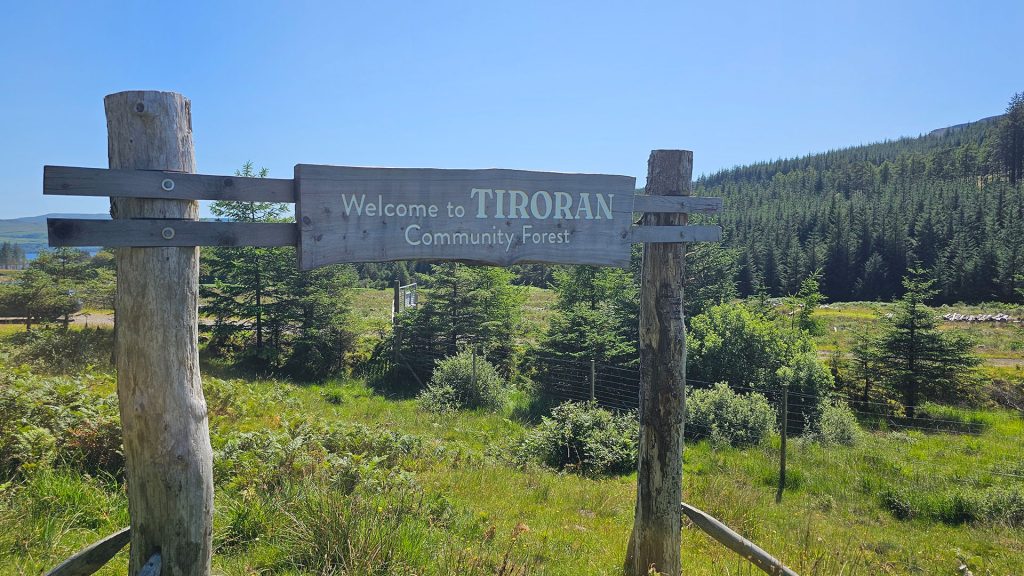
Tiroran is a vast forest tract covering 789 hectares in the southwest. The South West Mull and Iona Development owns this working forest, which includes unique community features such as the Woollen Woods art trail. The forest contains the abandoned settlement of Knockroy and a dedicated eagle hide. Meanwhile, management focuses on balancing timber extraction with tourism.
The Ancient Oakwoods and Special Areas of Conservation
Ardura Community Forest
Ardura sits in the southeast, spanning roughly 200 hectares. Now owned by the local community, this ancient woodland shelters centuries-old Sessile Oaks, Holly, and Birch. Residents are currently clearing away invasive species and old plantation timber, a vital effort that will eventually restore the Celtic Rainforest to its natural state.
Loch Ba Woodlands
The woodlands surrounding Loch Ba cover a scattered area of approximately 100 hectares. These are ancient, semi-natural woodlands composed primarily of Downy Birch and Sessile Oak. Nature has spaced the trees openly, allowing light to reach the forest floor. This supports a rich carpet of mosses and lichens.
River Ba Woodlands
The woodland strip along the River Ba extends for roughly 3 kilometers, covering approximately 40 hectares of riverbank. These trees stabilize the banks and provide shade for the water. This shade is crucial for spawning salmon and trout. The high humidity here makes it a prime location for rare oceanic bryophytes.
Coille na Sroine
Coille na Sroine covers approximately 50 hectares on the shores of Loch Ba. It is a core component of the Mull Oakwoods SAC. The terrain here is rough and steep, which has historically protected the trees from grazing and felling. This preserved a genetic lineage of ancient oak that is distinct from the planted forests.
Scarisdale Wood
Scarisdale Wood covers roughly 35 hectares near the coast of Loch na Keal. Oak and birch dominate this significant fragment of ancient semi-natural woodland. The wood sits on a steep slope, making it difficult to access. This inaccessibility has helped preserve its ancient character and diverse understory.
Coille na Creige Duibhe
This woodland covers a small but dense 25 hectares in Glen Clachaig. The name translates to Wood of the Black Rock. It remains a remnant of the vast forests that once covered the glens. Appropriately, it consists of hardy native species that cling to the rocky substrate.
Estate and Private Woodlands
Treshnish and Haunn Hazelwoods
This area covers approximately 60 hectares of discontinuous coastal strip. Located on the northwest coast, these are Atlantic Hazel woodlands, a rare habitat where the trees are often hundreds of years old. Remarkable lichen communities grow here, including species that experts find almost nowhere else in Europe.
Scallastle Nature Reserve
The Scallastle reserve covers roughly 200 hectares of regenerating land. Locals often refer to this area near Craignure as the Scallastle Scrub. The land is recovering from historical grazing and is now a thriving mix of young birch, oak, and hazel. It sits on the slopes of Beinn Chreagach and offers a glimpse into how the island’s woodland naturally regenerates.
Glengorm Castle Woods
The woodlands at Glengorm cover approximately 150 hectares of policy woodlands and shelterbelts. Previous owners planted these trees to protect the estate from the fierce Atlantic winds. Specifically, they include majestic beech avenues and mixed broadleaves that frame the castle grounds.
Torosay Castle Woods
Torosay Woods cover around 40 hectares connecting Craignure to the castle gardens. They feature a mix of native species and exotic garden plantings, creating a lush, dense environment that shelters the formal gardens. The path of the former narrow-gauge railway traverses the woods.

Duart Millennium Wood
This planted native woodland covers approximately 5 hectares. Located near Duart Castle, the estate created it to celebrate the millennium. It consists entirely of native species designed to replicate the natural scrub of Mull, including oak, ash, and rowan.
Lochbuie Woods
The Lochbuie coastal woods cover approximately 80 hectares around Moy Castle. The trees here, often oak and ash, grow close to the sea, and the salt wind prunes them constantly. They form a hanging garden effect on the cliffs and slopes surrounding the estate.
Carsaig Woods
Carsaig Woods cover a linear strip of approximately 50 hectares along the cliffs. These hanging woodlands cling to the steep cliffs near the famous Carsaig Arches. They are remnants of the ancient coastal forest cover. Fortunately, hardy native broadleaves dominate the site.
Croggan Woods
Croggan Woods cover approximately 30 hectares leading to Portfield beach. This area mixes native scrub and mature trees that shelter the small hamlet of Croggan. Uniquely, the woods sit in close proximity to the coast, where the trees often overhang the tidal waters of the loch.
